Dieng Plateau from Yogyakarta is a longer day trip than most visitors plan for — roughly two hours each way — which is exactly why it tends to stay off shorter itineraries and rewards the ones where it appears. The plateau sits at over 2,000 meters, looks nothing like the rest of central Java, and contains a cluster of 8th-century Hindu temples that predate both Borobudur and Prambanan by decades.
Dieng Plateau from Yogyakarta is one of those day trips that gets described as “underrated” in nearly every piece written about it, which is itself a sign that it’s not exactly undiscovered — but the description holds. The plateau sits in the highlands of Wonosobo district, roughly 120 kilometers northwest of Yogyakarta at an elevation that produces genuinely cool air, crater lakes, sulfuric vents, and a landscape that registers as categorically different from the temple plains and beach coastlines that define most Central Java itineraries. Getting there takes more time than Borobudur or Prambanan, which is why it tends to appear on longer trips rather than shorter ones — and why it’s worth planning for if you have the days.
What Dieng Plateau Actually Is
Dieng is a volcanic plateau in the Dieng Mountains, sitting between 2,000 and 2,500 meters above sea level. The name translates roughly as “abode of the gods” in Old Javanese, which reflects the area’s significance as a center of early Hindu religious activity — the temple complex on the plateau predates both Borobudur and Prambanan, with construction on the earliest temples beginning in the late 7th or early 8th century.
The landscape is the other defining feature: volcanic craters, colored sulfuric lakes, steaming vents, and an agricultural plateau covered in potato and carica fields at high altitude. The combination of ancient temples in a volcanic highland environment is genuinely unusual in Java, and the visual contrast with the lower-elevation landscapes most Yogyakarta visitors spend their time in is part of what makes the detour worthwhile.
The Temples: Older Than Borobudur
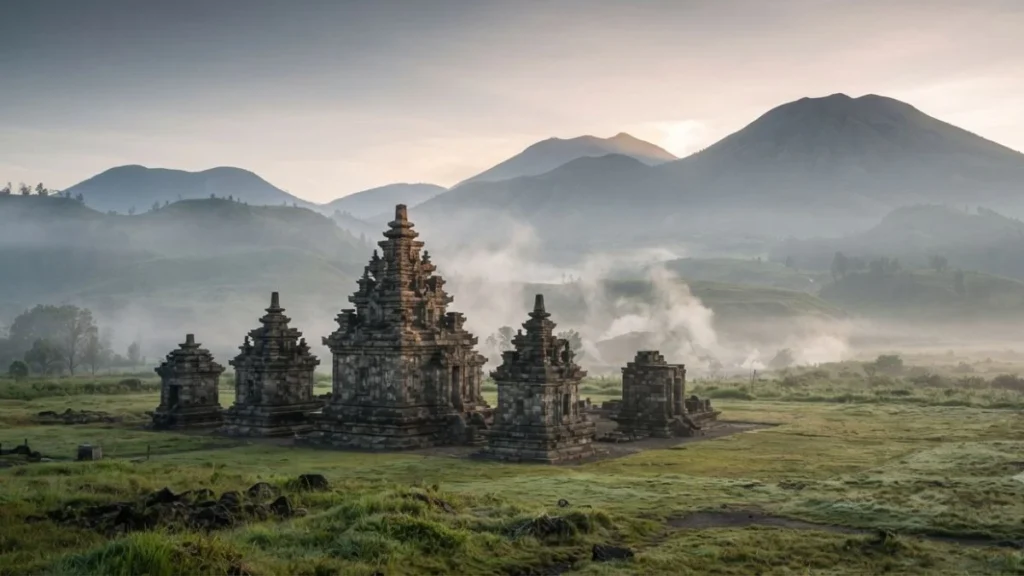
The Arjuna Temple Complex on the Dieng Plateau is a cluster of small stone Hindu temples — the surviving remnants of what was once a much larger complex, with estimates suggesting several hundred structures once covered the plateau. Eight structures survive in various states of preservation, clustered in a field at the center of the plateau.
The temples are smaller and less imposing than Prambanan’s towers, and visitors sometimes find the scale surprising after Prambanan or Borobudur. What they are, contextually, is more significant than they might appear at first sight: they are among the oldest surviving stone temples in Java, predating the great Buddhist and Hindu complexes of the Yogyakarta plain by a century or more, and they represent the earliest visible evidence of the court religious architecture that would eventually produce both Borobudur and Prambanan. Understanding them as a starting point rather than a lesser version of the later temples changes how they read considerably.
The site is well-maintained and walkable, with enough context in the surrounding museum to make the historical significance legible — the Dieng Plateau Museum near the temple complex is small but worth spending time in before or after the temples, and the English-language interpretation is adequate for independent visitors.
The Crater Lakes and Volcanic Features
Telaga Warna — the “colorful lake” — is the most visited of Dieng’s crater lakes, named for the shifting colors produced by the sulfuric mineral content of the water. The colors vary depending on time of day, season, and volcanic activity, ranging from pale turquoise to deep green and occasional yellow tones. It’s a short walk from the main road and is usually included as part of any Dieng day visit.
The Sikidang Crater is an active volcanic vent area where visitors can walk among steaming sulfuric vents and bubbling mud pools — the most viscerally geological part of the plateau, and the most immediately unusual for visitors whose frame of reference for “temple day trip” doesn’t usually include active volcanic features. It smells strongly of sulfur, the ground is uneven and warm in places, and the overall atmosphere is genuinely distinctive.
The combination of temple complex, crater lake, and active volcanic venting in the same highland plateau is what makes Dieng different from every other day trip option from Yogyakarta — it’s not any single feature but the accumulation of genuinely different things in a single landscape.
The Dieng Sunrise: Worth Planning Around
Dieng’s sunrise, viewed from the Sikunir Hill viewpoint, is one of the more discussed dawn experiences in Central Java — a view across the plateau with volcanic peaks visible in multiple directions and the early light catching the crater lakes and temple fields below. Getting there requires a 3am departure from Yogyakarta or an overnight stay in Wonosobo or on the plateau itself.
The honest comparison with Borobudur sunrise: Dieng’s sunrise viewpoint is less organized and less crowded than Borobudur’s managed system, produces a different kind of landscape view (broader and more volcanic rather than temple-focused), and requires significantly more effort to reach. For visitors specifically interested in highland volcanic landscape photography or willing to do an overnight trip, it’s worth planning around. For visitors who want a dawn experience without an overnight in a cold highland village, Borobudur’s managed sunrise — covered in the Borobudur from Yogyakarta guide — is more accessible.
Doing It as a Day Trip From Yogyakarta
Dieng as a day trip from Yogyakarta is possible but genuinely long — the drive takes roughly 2 to 2.5 hours each way depending on traffic through Wonosobo, which means a day trip requires leaving Yogyakarta by 6am to have meaningful time on the plateau before the return drive. It’s worth being realistic about this before committing: a full Dieng day trip is a 10 to 12 hour commitment from departure to return, and it deserves to be treated as a dedicated day rather than something squeezed around other activities.
The alternative that works better for some travelers is an overnight in Wonosobo or on the plateau itself — arriving in the afternoon, experiencing the sunset and the cold highland evening, doing the Sikunir sunrise, and returning to Yogyakarta the following morning. This produces a significantly better Dieng experience at the cost of one additional night away from the city base.
For how Dieng fits into the broader picture of what to do in the Yogyakarta region, the things to do in Yogyakarta guide covers the full range of day trip options and how to prioritize among them. The best time to visit Yogyakarta guide is also relevant here — Dieng at altitude is noticeably cooler and can be cold at night even during dry season, which affects packing and the overnight option.
Getting There From Yogyakarta
Dieng is most practically reached by private car or rented car with driver — the distance and the highland road require a vehicle, and the logistics of managing a connection through Wonosobo by public transport significantly extend the journey time. The road from Yogyakarta through Magelang or through Temanggung to Wonosobo and then up to the plateau is generally good quality on the main routes, though the final approach to the plateau involves a series of steep switchbacks that are fine for cars but require some driving comfort on a motorbike.
A rented motorbike is technically possible for the journey but makes for a very long and tiring day given the distance and the altitude change — more appropriate for riders with experience on highland roads than as a first-choice option. For most visitors, a private car with driver arranged through accommodation in Yogyakarta the evening before is the right call. The getting around Yogyakarta guide covers the private car arrangement logistics that apply here.
Frequently Asked Questions
How far is Dieng Plateau from Yogyakarta?
Dieng Plateau is roughly 120 kilometers northwest of central Yogyakarta, approximately 2 to 2.5 hours by car through Wonosobo depending on traffic. It’s the longest day trip in the standard Yogyakarta region, which is why it suits longer trips or an overnight rather than a tight three-day schedule.
Are the Dieng temples older than Borobudur?
Yes. The earliest temples on the Dieng Plateau date to the late 7th or early 8th century, predating Borobudur (built around 780–840 CE) and Prambanan (built around 850 CE) by several decades to a century. They represent some of the earliest surviving stone temple architecture in Java.
What should I wear to Dieng Plateau?
Significantly warmer layers than you’d need anywhere else in the Yogyakarta region — the plateau sits above 2,000 meters and temperatures at dawn can drop to 10°C or lower. A warm jacket, long trousers, and closed shoes are practical necessities rather than optional, particularly for sunrise visits or overnight stays.
Is Dieng Plateau worth visiting from Yogyakarta?
Yes, for travelers with the time to do it properly — either as a genuinely early start day trip (departing by 6am) or as an overnight that allows the sunrise experience. It offers a landscape and historical context genuinely different from every other site in the Yogyakarta region, and the combination of ancient temples, volcanic craters, and highland scenery is worth the effort for travelers with more than three days.