Borobudur from Yogyakarta is the most common day trip on any Java itinerary, and also the one most likely to be remembered for the wrong reasons — a two-hour queue in the sun, a guided walkthrough that moves too fast to see anything, or a sunrise slot that promised emptiness and delivered a crowd. Here’s the honest version of how to do it well.
Visiting Borobudur from Yogyakarta is something most travelers on a Java itinerary assume they’ll do without thinking too hard about it — it’s close, it’s famous, and it’s one of the largest Buddhist monuments in the world. All of that is true. What’s less discussed is that Borobudur is also one of the most heavily managed tourist sites in Indonesia, and the experience varies dramatically depending on when you go, how you get there, and what you’re actually trying to get out of it. This guide is the version that covers those variables honestly.
What Borobudur Actually Is
Borobudur is a 9th-century Mahayana Buddhist temple built during the Sailendra dynasty, constructed on a natural hill in the Kedu Plain about 40 kilometers northwest of Yogyakarta. It’s a mandala in three dimensions — a stepped pyramid of stone galleries arranged to represent the Buddhist cosmological universe, with 2,672 relief panels and 504 Buddha statues distributed across its levels, all oriented to be walked in a specific direction (clockwise, ascending) as a form of meditative pilgrimage.
That function — a site designed to be walked as practice, not viewed as spectacle — is worth knowing before you arrive, because it changes how the place reads once you’re actually moving through it. The relief panels tell stories from Buddhist scripture and from everyday 9th-century Javanese life; they’re not decorative in the conventional sense but narrative, meant to be read progressively as you ascend. Most visitors walk past them too quickly to follow any of it, which is a genuine loss given the detail.
Getting from Yogyakarta to Borobudur
The journey from Yogyakarta to Borobudur takes roughly 1 to 1.5 hours by car depending on traffic, covering about 40 kilometers northwest of the city. There are several ways to make the trip, each with a real trade-off.
The most flexible option is a private car or driver arranged through your accommodation or a local transport service — this gives you control over departure time (important for sunrise visits) and return timing, and eliminates the coordination complexity of shared transport on the way back when you’re tired and ready to leave. Costs vary but are manageable split across two or three travelers.
Ride-hailing apps (Gojek and Grab) cover the route from central Yogyakarta but reliability for longer-distance trips like this varies — some drivers decline the distance. A booked private driver, arranged the evening before, is more dependable for an early morning departure.
Public minibuses (trans Jogja to Jombor terminal, then onward connection) exist and are significantly cheaper, but the connection logistics and journey time make them impractical for a sunrise visit and moderately inconvenient for a standard morning one.
Sunrise at Borobudur: Honest Assessment
The Borobudur sunrise ticket — sold at a premium, requiring arrival before dawn, and marketed heavily as the way to experience the temple — is worth doing with some caveats that most promotional descriptions leave out.
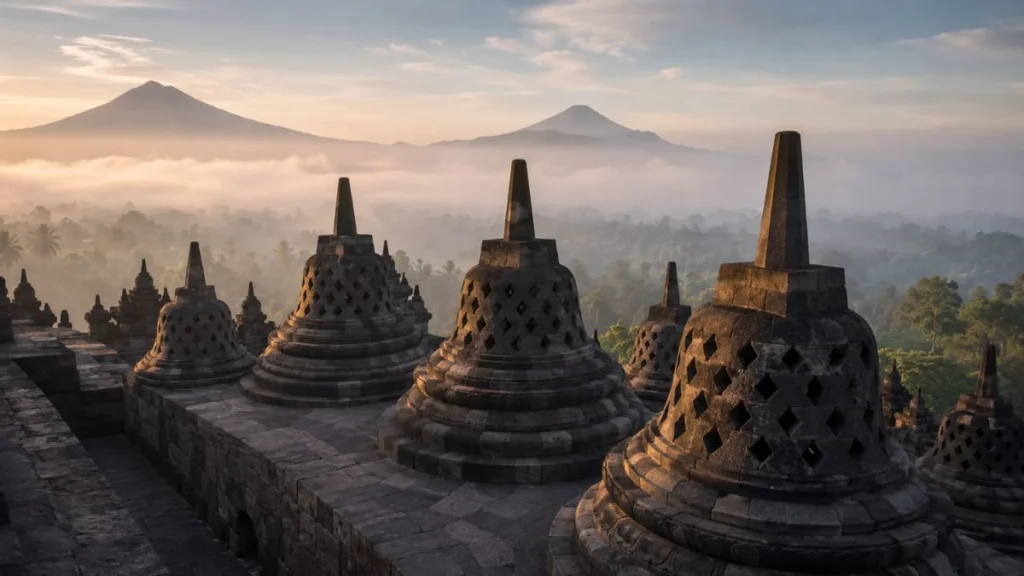
The sunrise itself, when it works, is genuinely spectacular: Merapi and Merbabu visible on the horizon, low mist across the Kedu Plain, the stupas silhouetted against a gradually lightening sky. This is real, and it photographs as well as it looks. The caveats: cloud cover is common and unpredictable, even in dry season, and a cloudy sunrise at Borobudur is simply a dark and expensive early morning. The sunrise slot also now draws enough visitors that it is not the solitary dawn experience it was a decade ago — you’ll share the upper terraces with a significant number of other sunrise ticket holders.
The practical recommendation: if the atmospheric sunrise experience is important to your trip, book it and accept the weather risk. If you’re primarily interested in the temple’s architecture and relief panels, a standard morning visit shortly after opening (7am) on a weekday gives you most of what a sunrise visit offers at a fraction of the cost, with better light for the reliefs once the sun is up.
How Much Time You Actually Need
Most tour packages and group itineraries allocate 1.5 to 2 hours at Borobudur, which is enough to walk the full route once at a moderate pace. It is not enough to actually read the relief panels with any attention, which take considerably longer to follow if that’s what you want to do.
A more honest allocation: 2.5 to 3 hours for travelers who want to move through the site with some care rather than completing it as a circuit. This includes time to sit on the upper terraces, which most visitors pass through quickly but which are the best place to simply be at Borobudur rather than move through it.
What Borobudur Is Not: Managing Expectations
Borobudur is not an intimate site. It is well-preserved, well-maintained, and genuinely impressive at a scale that’s difficult to convey without being there — but it is also a high-volume tourist destination managed accordingly, with ticket infrastructure, souvenir markets, and organized queues. First-time visitors sometimes arrive expecting something quieter or less developed and find the management apparatus surprising.
This is not a criticism of the site — the management is necessary given the volume of visitors and the fragility of the 9th-century stonework. It’s just worth knowing before you arrive expecting the atmosphere of a less-visited heritage site.
For a smaller, quieter alternative that offers a different kind of historical atmosphere, Ratu Boko is worth considering as a complement or alternative depending on your itinerary. We also cover how Borobudur fits into a realistic three-day schedule in the 3-day Yogyakarta itinerary, and the broader picture of how it sits alongside everything else worth doing in the things to do in Yogyakarta guide.
Frequently Asked Questions
How far is Borobudur from Yogyakarta?
Borobudur is roughly 40 kilometers northwest of central Yogyakarta, about 1 to 1.5 hours by car depending on traffic.
Is the Borobudur sunrise visit worth it?
It depends on weather and your priorities. On a clear day the sunrise view from the upper terraces is genuinely spectacular. On a cloudy day it’s an expensive early morning with limited visibility. If the relief panels and architecture are the primary draw, a standard morning visit shortly after opening offers similar access at lower cost.
How do I get from Yogyakarta to Borobudur?
The most practical option for independent travelers is a private car or driver arranged through accommodation the evening before — particularly for early morning or sunrise departures. Ride-hailing apps cover the route but vary in reliability for longer distances. Public transport connections exist but are time-consuming.
Can I visit Borobudur and Prambanan on the same day from Yogyakarta?
Technically possible but not recommended if you want to give reasonable time to either. They sit in opposite directions from Yogyakarta — Borobudur northwest, Prambanan east — which means the transit between them eats significantly into the day. Better treated as separate day trips, as we cover in the 3-day Yogyakarta itinerary.