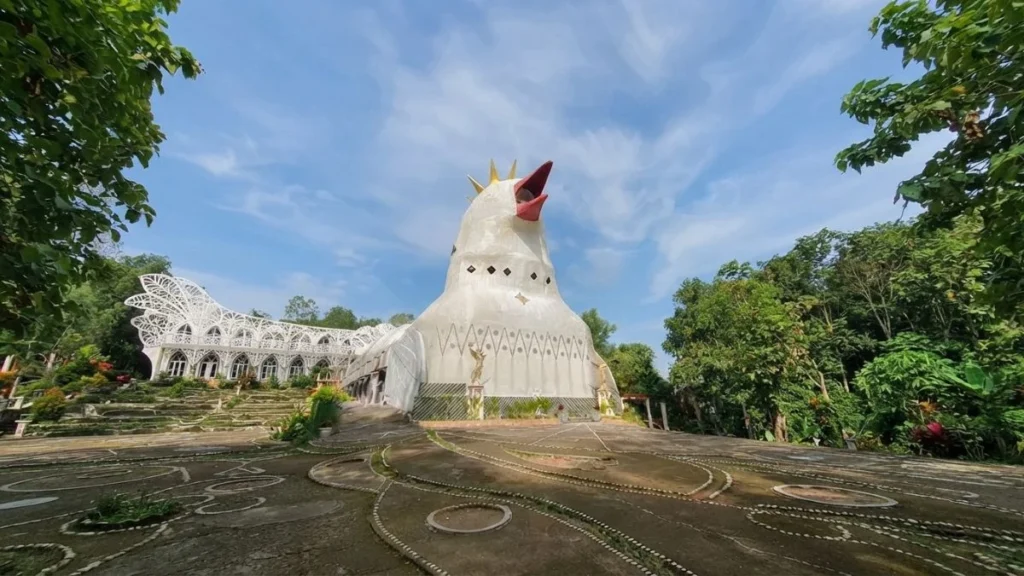
Chicken Church Yogyakarta — or Gereja Ayam, as it’s locally known — is one of those sites that circulates endlessly on travel social media and gets described in almost exactly the same way every time: “an abandoned prayer house shaped like a chicken in the jungle.” That description is accurate and tells you almost nothing useful about what visiting it actually involves. Here’s the honest version.
Chicken Church Yogyakarta sits in the hills of Magelang, roughly 40 kilometers northwest of central Yogyakarta near the village of Bukit Rhema, and it draws a steady stream of visitors who’ve seen the same photographs of a concrete bird-shaped building emerging from forest. The building is real, it does look like a chicken from certain angles (though its builder maintained it was always intended as a dove), and the surrounding hillside has genuine atmosphere at the right time of day. What most write-ups skip is the access reality, the commercialization trajectory since the site went viral, and whether the experience matches the expectation the photographs set up.
What Chicken Church Actually Is
Gereja Ayam was built by Daniel Alamsjah, a local man who said he received a divine vision in the 1990s instructing him to build a prayer house in the form of a dove on the hill above Bukit Rhema. Construction began in 1992 and continued intermittently for years without ever being fully completed — the building was used as a prayer and rehabilitation space for a period, fell into disuse and partial abandonment, and then was rediscovered by the internet around 2016 when photographs of the overgrown, semi-ruined structure began circulating widely.
The viral moment turned Chicken Church from an obscure local curiosity into a significant tourist destination, which has produced the predictable result: the site has been cleaned up, ticketed, and organized for visitors in ways that have reduced the semi-abandoned atmosphere that made the original photographs compelling. The building is no longer genuinely abandoned — it’s a managed attraction with an entry fee, a surrounding market of souvenir stalls, and a visitor flow that peaks on weekends.
This isn’t a reason not to visit, but it is the most important piece of context for calibrating expectations. The photograph circulating online was taken at a specific moment in the site’s history that no longer exists in that form.
The Hike and What It Involves
The approach to Chicken Church involves a hike up the hillside from the parking area — not a technically demanding trail, but a genuine uphill walk of 20 to 30 minutes that most descriptions undersell. In Yogyakarta’s heat and humidity, this matters practically: arriving at the top hot, sweaty, and slightly out of breath before you’ve seen anything is the standard experience, and it’s worth factoring into your energy budget for the day.
The interior of the building can be climbed — there are internal ramps and stairways leading up through the structure to a viewpoint at the top of the “head,” which looks out over the surrounding forest and hills toward Borobudur on a clear day. This is the most worthwhile part of the visit for most people: the views from the top, particularly in early morning before cloud cover builds, are the genuine payoff that the exterior photographs don’t show. The building’s interior is bare concrete throughout — there’s no historical collection or interpretive display, and the atmosphere is entirely dependent on the light and the views rather than any curatorial content.
Best Time to Visit
Early morning is the clear recommendation — arriving at the site shortly after opening, ideally on a weekday, gives you the best light for photography, the clearest views toward Borobudur, and the lowest visitor density. By mid-morning on weekends the site becomes significantly more crowded, and the combination of crowds and midday heat reduces the experience to something closer to a crowded viewpoint than a peaceful hillside discovery.
The site sits close enough to Borobudur — roughly 15 to 20 minutes by road — that combining a morning Borobudur visit with an afternoon or early-morning Chicken Church stop makes geographical sense. The reverse works slightly less well given that both sites benefit from early morning light and early morning visits require choosing between them unless you’re staying in the Magelang area rather than central Yogyakarta. The full logistics of visiting Borobudur from Yogyakarta are covered separately.
Is It Worth the Trip From Yogyakarta?
The honest answer depends on what’s driving the interest. If the draw is specifically the architectural curiosity and the views from the top — and you’re going on a weekday morning with calibrated expectations about what the site currently looks like — it’s a worthwhile half-day addition to a Magelang-area day, particularly when paired with Borobudur.
If the draw is primarily the semi-abandoned jungle atmosphere of the viral photographs, that version of the site no longer exists in the same way, and the gap between expectation and reality is large enough to produce genuine disappointment.
For visitors whose Yogyakarta itinerary is already full with the core sights — the Kraton, Taman Sari, Kotagede, the temple day trips — Chicken Church is an addition for a longer trip rather than a priority for a shorter one. The things to do in Yogyakarta guide covers what deserves priority in a standard Yogyakarta trip, and the 3-day Yogyakarta itinerary shows where the core sights sit in a realistic schedule. Chicken Church fits naturally into a fourth or fifth day, or as a Borobudur-day addition, rather than as a standalone destination requiring a separate trip from Yogyakarta.
Getting There From Yogyakarta
Chicken Church is not on any practical public transport route from Yogyakarta. A private car, rented motorbike, or ride-hailing app are the realistic options — the site is roughly 40 kilometers northwest of the city center, about an hour by car. The road through Magelang is generally good and the final approach to the parking area is signposted, though the last section of road narrows. The getting around Yogyakarta guide covers the motorbike rental and private car options that apply for this kind of out-of-city trip.
Frequently Asked Questions
Why is it called Chicken Church Yogyakarta?
The building was designed as a dove — its builder Daniel Alamsjah intended it to represent peace — but its silhouette, particularly from certain angles, reads more clearly as a chicken, and the nickname stuck. Locally it’s known as Gereja Ayam (literally “chicken church”) even though it was built as a non-denominational prayer house rather than a church in the conventional sense.
Is Chicken Church still abandoned?
No — the site was cleaned up and opened as a ticketed tourist attraction following its viral moment around 2016. The semi-abandoned atmosphere that characterized the original viral photographs no longer exists in the same form. The building is maintained, entry is ticketed, and the surrounding area has a market of souvenir stalls.
How far is Chicken Church from Yogyakarta?
Roughly 40 kilometers northwest of central Yogyakarta, in the Magelang area near Bukit Rhema village — approximately one hour by car depending on traffic.
Can I combine Chicken Church with Borobudur?
Yes, and this is the most practical way to include both in a single day given their proximity — roughly 15 to 20 minutes apart by road. Early morning at one site and mid-morning at the other is the most workable combination, though both benefit from early morning timing, which requires choosing which to prioritize for the first slot.