Last updated: 7 August 2026
Order satay almost anywhere else in Indonesia and you’ll get bamboo skewers and a sweet peanut sauce. Order it in Bantul and you’ll get goat meat threaded onto actual bicycle spokes, seasoned with little more than salt, and served with nothing to hide behind.
Quick Facts
- What it is: Young goat satay grilled on metal bicycle-spoke skewers, seasoned mainly with salt
- Where it started: Pleret and Wonokromo area, Imogiri Timur Street, Bantul
- Price: Roughly Rp 20,000–35,000 per portion (2 skewers)
- Best known spot: Sate Klathak Pak Pong, Jl. Imogiri Timur Km. 7, Bantul
- Served with: Gulai (goat curry gravy), rice, raw shallots, and bird’s eye chilies
Sate Klathak is Yogyakarta’s answer to the question of what happens when you strip satay down to almost nothing but the meat. Instead of the sweet soy and peanut sauce found on satay elsewhere in Indonesia, this version relies on young goat meat, salt, a little pepper, and a grilling method built around metal skewers rather than bamboo — a detail that gives the dish both its texture and its name.
Where the Name Comes From
According to Indonesia’s official tourism board, the name “Klatak” is believed to come from one of two sources: the crackling sound made when fat from the grilling goat meat drips onto hot charcoal, or the Javanese word kelatak, which can refer to simple, minimal seasoning — in this case, just salt. Either explanation points to the same idea: this is a dish defined by restraint rather than a heavy spice rub, and the sound and simplicity are both baked into the name itself.
Local accounts trace the dish’s roots to the Pleret and Wonokromo area of Bantul, with different sources crediting either Mbah Ambyah in the 1940s or a family operation that formalized into a permanent stall by 1960 as the pioneers. The most consistent detail across accounts is the bicycle-spoke skewer itself — a practical fix rather than a gimmick, since metal conducts heat more evenly than bamboo, cooking the goat through without burning the outside.
Why Bicycle Spokes, Specifically
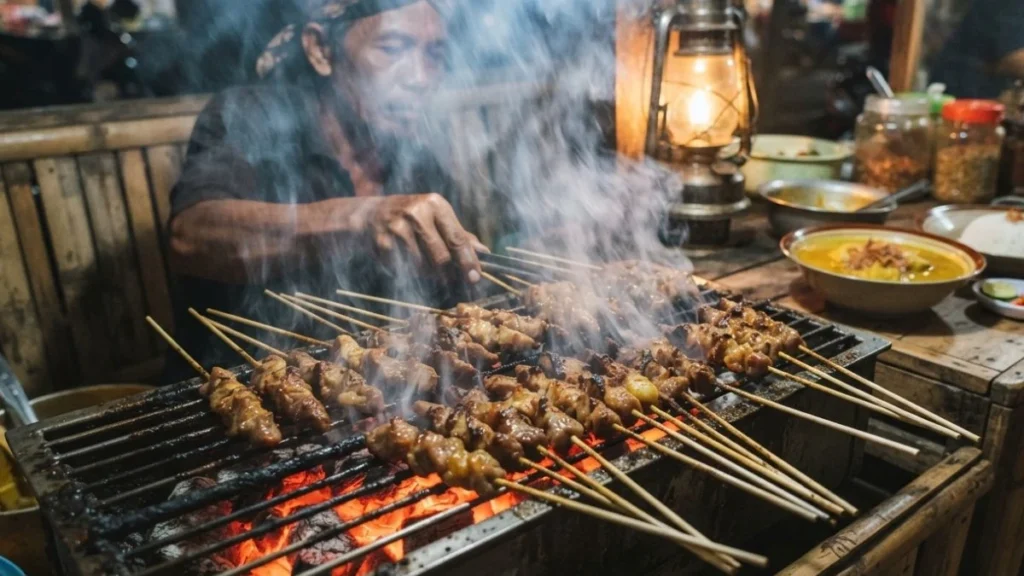
The skewer choice sounds unusual until you understand what it’s solving. Metal transfers heat from the charcoal directly into the center of the meat, allowing thicker cuts of young goat to cook evenly from the inside out rather than charring outside while staying raw in the middle. Iron spokes are also reusable and sturdier than single-use bamboo, which matters at a stall grilling large volumes of meat daily. The pieces of goat used for sate klathak also tend to run larger than typical satay cuts, and only a metal skewer can reliably hold that size and weight over an open charcoal grill.
What’s on the Plate
A portion is typically just two skewers, but the pieces are large enough that this alone works as a meal alongside rice. The meat itself carries minimal seasoning — salt and a touch of pepper — letting the goat’s own flavor and the charcoal smoke do the work. What completes the dish is the accompaniments: a bowl of gulai, a rich yellow curry gravy that doubles as a dip or gets poured directly over the rice, plus raw sliced shallots and bird’s eye chilies on the side for anyone who wants extra heat. Some stalls also serve tongseng (a spiced goat stew) and tengkleng (a bone-heavy goat soup) from the same kitchen for people who want more variety beyond the skewers.
Where to Try It
Jalan Imogiri Timur in Bantul remains the center of sate klathak culture, and Sate Klathak Pak Pong is the name most visitors hear first — a long-running family operation now split across a stone building and an open-air pendopo across the street from each other. Expect a wait during peak meal times, since the format doesn’t scale quickly: each skewer is grilled fresh to order over charcoal.
The Bantul stretch sits south of central Yogyakarta, making it a reasonable stop if you’re already heading toward imogiri royal cemetery or looping back from parangtritis beach. It’s a different kind of food detour than the kopi joss and gudeg stops closer to the city center, and worth building into a day that already has you south of Yogyakarta.
Practical Tips
- Go hungry, not rushed. Popular stalls grill each order fresh, so expect a genuine wait, especially on weekends.
- Order the gulai on the side. It’s meant to be dipped into or poured over rice rather than treated as a garnish — skipping it misses half the dish.
- Ask about spice level. The raw chilies served alongside are optional heat, not built into the meat itself, so you control how spicy your plate gets.
- Bring cash. Like most standalone warung in the area, card payment isn’t a given.
Is It Worth the Trip Out to Bantul?
Yes, particularly for visitors who’ve already tried Indonesia’s more familiar sweet-and-peanut satay elsewhere and want to taste a genuinely different regional take. Sate klathak isn’t trying to be universally crowd-pleasing — it’s built around minimal seasoning and unusual technique, which is exactly what makes it worth the detour south of the city.
What does “klathak” actually mean?
It likely refers either to the crackling sound the meat makes on the grill or to the Javanese word for simple, minimal seasoning — both point to the dish’s stripped-down character.
Is sate klathak really grilled on bicycle spokes?
Yes — metal rods based on bicycle spoke design are used instead of bamboo skewers, chosen because metal conducts heat more evenly into thicker cuts of goat meat.
Does sate klathak come with peanut sauce?
No — unlike most Indonesian satay, it’s seasoned mainly with salt and served with a goat curry gravy called gulai rather than peanut sauce.
Where is the best place to try sate klathak in Yogyakarta?
Jalan Imogiri Timur in Bantul is the historic center of the dish, with Sate Klathak Pak Pong as the most widely known stall.
How much does a portion of sate klathak cost?
A typical two-skewer portion runs roughly Rp 20,000–35,000, though prices vary slightly by stall and whether you add tongseng or tengkleng.
Sumber Resmi
- Kementerian Pariwisata RI — Indonesia.travel: Sate Klatak (diverifikasi aktif via fetch, diakses 7 Agustus 2026) — sumber resmi Kementerian Pariwisata untuk asal-usul nama dan teknik memanggang