Last updated: 7 August 2026
Walk through a Dutch colonial fort, a Chinatown street, and a centuries-old Javanese village market in the space of twenty minutes — all without leaving one field in Sleman. Studio Alam Gamplong is a working film set that just happens to also be one of Yogyakarta’s most photographed places.
Quick Facts
- What it is: A former film set turned open-air tourist attraction, built from real movie sets
- Where it is: Gamplong 1, Sumberrahayu, Moyudan, Sleman — about 16km from Yogyakarta’s zero point
- Entry: Free (voluntary donation); some individual buildings charge around Rp 10,000
- Hours: Daily, roughly 8 AM–5 PM
- Best for: Photography, families, and anyone curious about how Indonesian period films get made
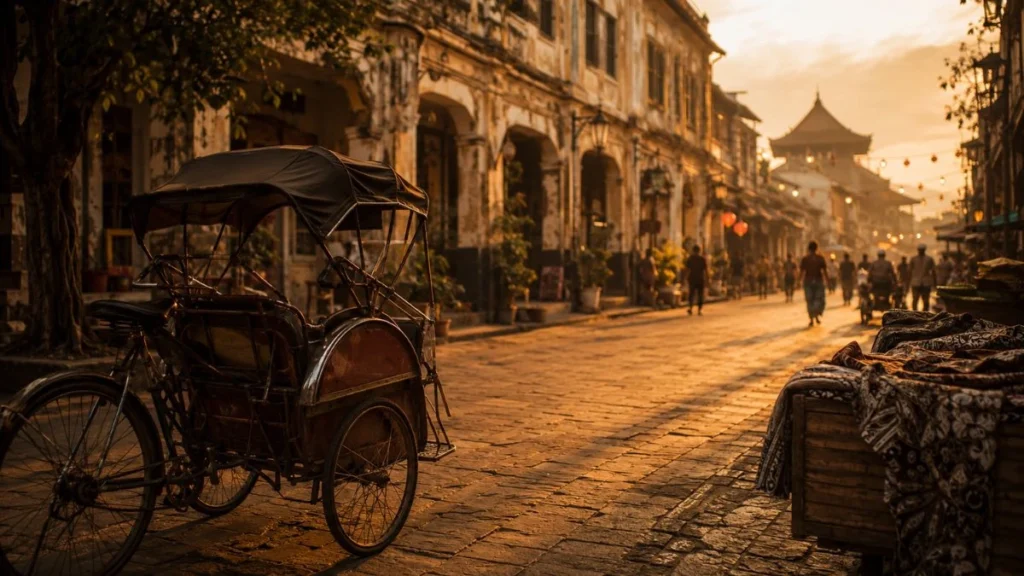
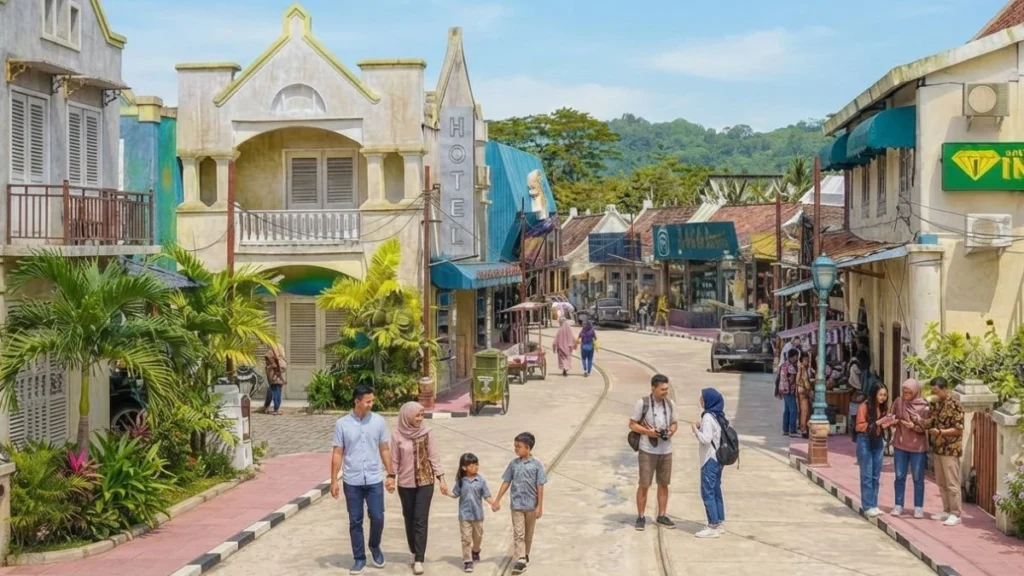
Studio Alam Gamplong sits in Sleman Regency, about 16 kilometers from Yogyakarta’s city center, and it’s exactly what it sounds like: a real film studio built in the open air, later opened to the public. Locals often call it Indonesia’s “mini Hollywood” — not because it resembles the actual Hollywood sign, but because of what’s inside: full-scale replicas of a Dutch colonial fort, a Chinatown street, a traditional market, and a cluster of Javanese-style buildings, all originally constructed for movie productions.
How It Started
The studio’s origin traces back to businesswoman Mooryati Soedibyo, founder of the cosmetics company Mustika Ratu, who wanted to fund a film centered on leadership and character development. According to Yogyakarta’s official tourism portal, the story of Sultan Agung was chosen as the inspiration, and after searching for a suitable filming location, Gamplong was selected as the site. The result was the 2018 film Sultan Agung: Tahta, Perjuangan, Cinta, directed by Hanung Bramantyo, which used the location to recreate 16th- and 17th-century Indonesia — a period when Dutch colonial influence was expanding, which is why the site includes a Dutch-style fort alongside Javanese and Chinese-influenced buildings.
Once filming wrapped, the production team behind Mooryati Soedibyo donated the studio to the local government rather than tearing the sets down. The site was later used again for the 2019 film Bumi Manusia, based on Pramoedya Ananta Toer’s novel, which brought a fresh wave of visitors and cemented the studio’s reputation as a place worth visiting even without a film shoot happening. Before any of this, the land was a sugarcane field supplying a local sugar factory — a detail that surprises most visitors given how developed the site now looks.
What’s Actually There
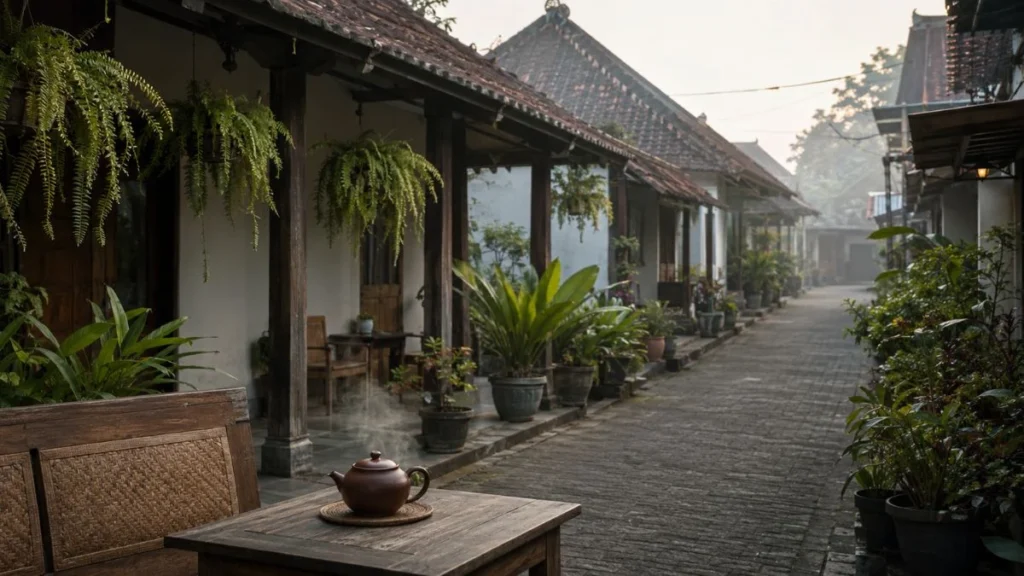
The site spans a few hectares and is organized into distinct zones rather than one continuous set. Expect a Dutch-era fort complete with a large gate and a symbolic moat-like river out front, a Chinatown-style street (Pecinan), a Kranggan residential zone with Javanese-style houses, and a recreated traditional market selling replica fruit, vegetables, and old-style wooden food stalls, complete with props like paper umbrellas and oversized woven baskets. Some structures used in Bumi Manusia — including a version of a character’s house that was fitted out as a small library with real books — remain standing and open for visitors to walk through.
Because the site is a working film location as well as a tourist attraction, parts of it change periodically to suit new productions, meaning what you see on one visit may not be exactly what’s there on the next. It’s also why entry to individual buildings sometimes requires a separate small ticket on top of the general voluntary entry — those buildings are treated as maintained assets rather than open public space.
Practical Details
Entry to the grounds themselves is by voluntary donation rather than a fixed ticket price, though visiting some of the individual film-set buildings costs a small fee, commonly cited around Rp 10,000 per building. Parking is a separate, low-cost fee for motorbikes and cars. The studio is open daily, and most visitors plan a couple of hours here, which fits comfortably alongside a day trip toward pine forest yogyakarta or a stop near kaliurang yogyakarta if you’re already exploring Sleman’s highland side.
Practical Tips
- Go early or late in the day. The open-air sets offer little shade, and Sleman afternoons get hot — morning light also photographs better against the aged building facades.
- Bring small cash. Both the donation gate and individual building tickets typically expect cash, and change isn’t always guaranteed.
- Expect it to feel different each visit. Because it’s still an active filming location, sets are sometimes altered, aged further, or partially closed for productions.
- Pair it with nearby stops. Gamplong sits closer to Sleman’s western side, making it a reasonable combination with other half-day attractions rather than a full standalone trip from central Yogyakarta.
Is It Worth Visiting?
For anyone who enjoys photography, period architecture, or just wants to see how Indonesian film crews build an entire historical world from scratch, yes — Studio Alam Gamplong delivers a genuinely different kind of Yogyakarta stop compared to temples or beaches. It won’t suit visitors looking for a purely natural or spiritual experience, but as a photogenic, low-cost half-day detour, it consistently earns its reputation as one of Sleman’s more inventive attractions.
How much does it cost to enter Studio Alam Gamplong?
General entry is by voluntary donation rather than a fixed price, though entering individual film-set buildings typically costs a small separate fee, often cited around Rp 10,000 each.
What films were shot at Studio Alam Gamplong?
The site was originally built for Sultan Agung: Tahta, Perjuangan, Cinta (2018) and was later used for Bumi Manusia (2019), both directed by Hanung Bramantyo.
How far is Studio Alam Gamplong from central Yogyakarta?
It’s located in Moyudan, Sleman, roughly 16 kilometers from Yogyakarta’s zero point, making it about a 30–45 minute drive depending on traffic.
Is Studio Alam Gamplong a real film studio or just a themed attraction?
It’s a genuine former film set — the buildings were originally constructed for actual movie productions and were later donated to the local government rather than being built purely for tourism.
What should I bring to Studio Alam Gamplong?
Cash for entry and parking, a camera, sun protection, and comfortable shoes, since the site involves walking across an open outdoor area with limited shade.
Sumber Resmi
- Dinas Pariwisata Daerah Istimewa Yogyakarta — Studio Alam Gamplong (diverifikasi aktif via fetch, diakses 7 Agustus 2026) — sumber resmi Dinas Pariwisata DIY untuk sejarah dan asal-usul studio