Yogyakarta packing list decisions are different from Bali packing decisions in ways that most combined Indonesia packing lists don’t address. The city is hotter and more conservative than Bali’s south coast, the day trips span highland cold and beach heat within the same week, and the temple and market circuit requires different clothing logic from a resort-focused trip. This list covers what actually matters, specifically for Yogyakarta.
Yogyakarta packing works best when it starts from the specific rather than the general. Generic Southeast Asia packing lists miss the Yogyakarta-specific variables: the conservative cultural context that affects what you wear in most of the city’s significant sites, the temperature range across a single week that can span 32°C on the Prambanan plain and 10°C at dawn on the Dieng Plateau, and the practical reality of navigating markets, craft workshops, cave tubing, and temple visits in the same trip without over-packing for any of them.
Clothing: The Core Logic for Yogyakarta
The guiding principle for Yogyakarta clothing is modest and layerable rather than beach-casual or resort-wear. This isn’t about strict rules — it’s about the practical reality that most of what makes Yogyakarta worth visiting (the Kraton, Kotagede workshops, Pasar Beringharjo, active temples, local warungs) either requires or is significantly more comfortable in clothing that covers shoulders and knees.
Lightweight long trousers or midi skirts (2–3 pairs): The most versatile bottom option for Yogyakarta. Linen or light cotton works in the heat; these also function for temple visits without needing to borrow a sarong. Avoid shorts as your primary option — you’ll either be hot and inappropriately dressed at cultural sites or over-packing two different clothing systems for the same trip.
Lightweight short-sleeved shirts (3–4): The standard upper body option for the city’s daily temperature. Cotton or moisture-wicking synthetic depending on your preference — both work, cotton breathes better in the market heat, synthetic dries faster if you’re moving accommodations frequently.
One or two long-sleeved layers: Essential for the Dieng Plateau or Kaliurang highlands, where temperature at altitude drops significantly below what the city forecast suggests — dawn at Dieng can reach 10°C even in dry season. A light merino or synthetic base layer packs small and covers the range.
One lightweight jacket or windbreaker: Worth bringing for highland day trips and early morning departures (the Borobudur sunrise trip, Dieng at dawn) where the pre-sun temperature is genuinely cold. A packable down or synthetic jacket works; a light rain shell doubles as windproofing.
A light scarf or pashmina: The single most versatile item on the Yogyakarta packing list. Functions as shoulder cover for temple visits when you don’t want a full layer, as a layer in cold-air-conditioned restaurants and transport, as a head cover when useful, and as an impromptu wrap on cold highland mornings. One is enough.
Comfortable walking shoes (closed-toe): Required for Jomblang Cave and any hiking around the Merapi area; strongly recommended for market walking where sandals meet crowded uneven floors and the occasional wet produce section. A lightweight pair of trainers or trail shoes covers most situations.
Sandals (one pair): Useful for general city movement, guesthouse walking, and beach days at Gunungkidul. Birkenstocks or equivalent — something with enough structure for moderate walking — rather than flip-flops that won’t survive a full Pasar Beringharjo morning.
Swimwear: Worth packing if a Gunungkidul beach day or accommodation with a pool is on the itinerary. Not the priority it would be for Bali. One piece is sufficient.
Practical Gear: What Earns Its Place in the Bag
Daypack (15–20L): Essential for day trips to Borobudur, Dieng, Jomblang Cave, and Gunungkidul. A packable lightweight version that folds into itself is the most efficient option if you’re already carrying a main bag.
Reusable water bottle with filter or UV purifier: Tap water in Yogyakarta is not drinkable, and the plastic bottle consumption on a week-long trip is both expensive and avoidable. A filter bottle (LifeStraw or Sawyer Squeeze-compatible) or a UV purifier (SteriPen) covers the gap without requiring you to buy water constantly.
Portable power bank: The day trips to Jomblang Cave, Dieng, or Gunungkidul are full-day affairs without reliable charging access. A 10,000mAh power bank covers a phone and camera through a full day without needing to manage charging anxiety.
Headlamp or torch: Required for Jomblang Cave (provided by the operator, but having your own gives more control) and useful for any early morning departure in highland areas where mobile phone torch is not sufficient.
Lightweight rain cover for daypack: The wet season makes this essential; even dry season Yogyakarta produces occasional heavy afternoon showers. A pack cover weighs almost nothing and saves significant hassle.
Small padlock: Useful for guesthouse lockers and for securing your main bag in transit. Not emergency equipment, but worth the 50g.
Health and Pharmacy Essentials
Prescription medications in original packaging with documentation: Indonesian pharmacy availability varies — bring enough of any prescription medication for the full trip plus buffer, and carry documentation in case of customs questions.
Oral rehydration salts (ORS): The most useful single health item for Southeast Asia travel — stomach upsets and dehydration are both more likely in the heat, and ORS is the first-line response for both. Available in Yogyakarta pharmacies (Apotek) but worth having immediately accessible rather than sourcing on arrival when you need it.
Antidiarrheal (Imodium or equivalent): For situations where you need to manage symptoms through a day trip or transport leg rather than immediately treating the cause.
Antihistamine: For reactions to insect bites, dust in cave environments (Jomblang, Goa Pindul), and general allergy management.
Sunscreen (SPF 50+): Yogyakarta’s equatorial sun at the temple sites and Gunungkidul beaches is intense — bring sufficient quantity from home as international-brand sunscreen in Yogyakarta is available but expensive and often in lower SPF options than you’d choose.
Insect repellent (DEET or picaridin): Relevant for highland and cave areas more than the city center. The Merapi slopes around Kaliurang and the Gunungkidul beach areas have more mosquito activity than central Yogyakarta.
Small first aid kit: Plasters, antiseptic wipes, blister treatment. The cave and highland day trips involve terrain that produces minor injuries more often than city walking does.
Documents and Money
Passport with at least 6 months validity: Indonesian immigration requires this, and enforcement is genuine.
Printed and digital copies of key documents: Passport photo page, travel insurance policy, accommodation bookings for the first night. Printed copies are specifically useful when digital access is unavailable — arriving at a guesthouse after a long train journey with a dead phone is the scenario where a printed booking confirmation earns its weight.
Two payment cards (different networks): ATM availability in Yogyakarta is good in the city center but thinner in highland and coastal areas. Having two cards on different networks (Visa and Mastercard) covers ATM compatibility variation and provides a backup if one is blocked for international transactions.
Cash in Indonesian Rupiah: Many warung, market vendors, angkringan, and smaller guesthouses operate cash-only. Having local cash from the first day is more practical than assuming card payment covers everything. Airport ATMs on arrival work; money changers in central Yogyakarta near Malioboro also offer competitive rates.
Travel insurance policy documentation: The healthcare consideration for Yogyakarta is covered in more depth in the healthcare and safety in Yogyakarta guide, but the short version is that travel insurance covering medical evacuation is worth having and the documentation worth having accessible.
What Not to Pack
Heavy or formal clothing: There is no situation in a standard Yogyakarta trip that requires a blazer, formal shoes, or anything that can’t be worn on a warm day outdoors. Leave these at home.
Multiple pairs of shorts: Shorts work at the Gunungkidul beach and potentially at your accommodation, and that’s about the full extent of their usefulness on a Yogyakarta trip centered on cultural sites, markets, and temples. One pair is enough; more is unnecessary weight.
Full-size toiletries: Shampoo, conditioner, body wash, and most toiletries are widely available in Yogyakarta’s Indomaret and Alfamart convenience stores at lower prices than travel sizes from home. Pack a small amount for the first night and buy locally from day one.
Too many shoes: The closed-toe shoes plus sandals combination covers the full range of Yogyakarta activities. Adding a third pair adds weight without adding meaningful capability for a standard trip.
The Yogyakarta Packing Checklist Summary
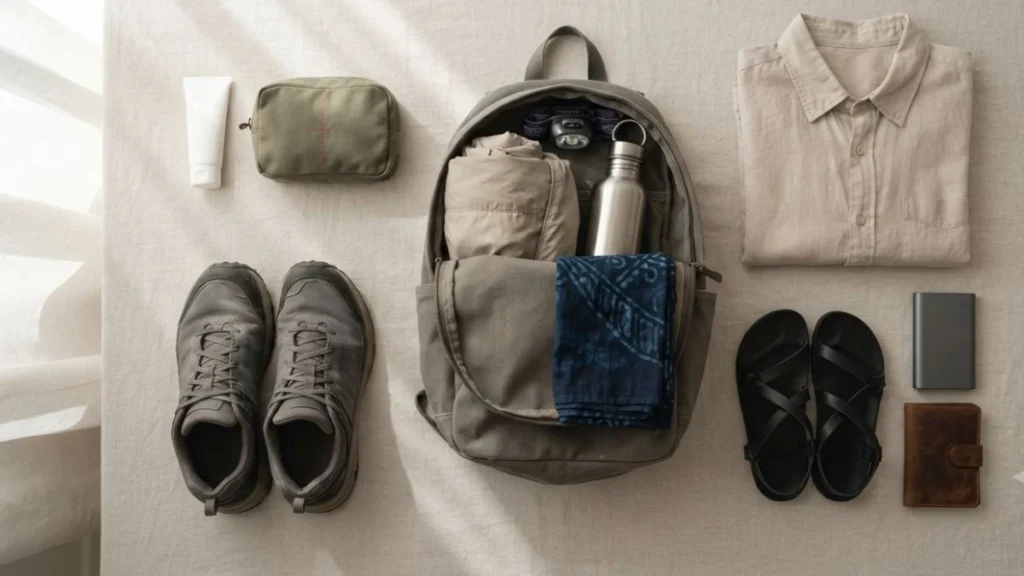
Clothing: 2–3 long trousers/midi skirts, 3–4 short-sleeved shirts, 1–2 long-sleeved layers, 1 packable jacket, 1 light scarf, closed-toe walking shoes, sandals, swimwear.
Gear: Daypack, reusable water bottle with filter, power bank, headlamp, rain cover, small padlock.
Health: Prescription medications, ORS, antidiarrheal, antihistamine, sunscreen SPF 50+, insect repellent, small first aid kit.
Documents and money: Passport, document copies, two payment cards, Rupiah cash, travel insurance documentation.
For the cultural context that shapes some of these clothing decisions — particularly around temple visits, the Kraton, and conservative neighborhood navigation — the Javanese culture and etiquette guide covers the reasoning behind the modest clothing principle in more depth than a packing list can. For the specific day trips that drive the layering requirement (Dieng Plateau, Kaliurang highlands), the Dieng Plateau guide and Kaliurang Yogyakarta guide cover what to expect on the ground.
Frequently Asked Questions
What should I wear at temples in Yogyakarta?
Covered shoulders and knees are required at Prambanan and recommended at Borobudur and smaller temple sites. Lightweight long trousers and a short-sleeved shirt with a scarf to cover shoulders if needed is the most practical combination — it covers the temple requirement without requiring a full change of outfit for the rest of the day.
Is it cold in Yogyakarta?
The city itself is consistently warm — 24°C to 32°C year-round — and does not require warm clothing. The highlands around Kaliurang are noticeably cooler (particularly in the morning), and the Dieng Plateau at altitude can drop to 10°C or below at dawn. A packable jacket and long-sleeved layer covers the full temperature range across a typical Yogyakarta week.
Can I buy things I forget in Yogyakarta?
Yes — most basic toiletries, over-the-counter medications, and everyday items are available in Indomaret or Alfamart convenience stores across the city. Branded sunscreen, specific medications, and specialized outdoor gear are harder to source and worth bringing from home.
Do I need to bring a sarong to Yogyakarta?
Not necessarily — temple sites that require one typically have sarongs available to borrow or rent at the entrance. A lightweight scarf that can double as a shoulder cover serves the same function for most cultural site visits without the bulk of a full sarong.