Yogyakarta budget planning is one of those topics where the numbers online are almost always either outdated or written for a travel style that doesn’t match yours. This guide covers what things actually cost in 2026 — accommodation, food, transport, and entry fees — with honest context for different spending levels rather than a single daily budget that fits no one precisely.
Yogyakarta budget planning starts with understanding that the city operates across a wider price range than most visitors expect. It’s genuinely cheap for travelers who eat where locals eat, sleep outside the main tourist corridor, and move around by ride-hailing rather than arranged tours. It’s considerably more expensive for travelers who stay in the boutique hotel tier, eat primarily at tourist-facing restaurants, and book packaged day trips to Borobudur and Prambanan. Both versions are reasonable depending on what kind of trip you want — the numbers below cover both ends and the middle, rather than collapsing them into a single daily figure that describes neither.
Accommodation: What You Get at Each Price Point
Yogyakarta accommodation ranges from basic guesthouse rooms to boutique heritage properties, with most independent travelers landing somewhere in the middle tier.
At the budget end — roughly IDR 150,000 to IDR 350,000 per night (approximately USD 9–22) — you’re in basic guesthouse or hostel territory: a clean room, a fan or basic air conditioning, and usually a simple breakfast included. The Prawirotaman area has the most concentration of this tier for independent travelers, and the quality within this range varies enough that reading recent reviews before booking matters.
The mid-range tier — roughly IDR 400,000 to IDR 900,000 per night (approximately USD 25–56) — covers most of the comfortable guesthouse and small hotel options in Yogyakarta, including some of the more atmospheric family-run properties in Kotagede and near the Kraton. Air conditioning is standard, rooms are generally well-maintained, and breakfast quality starts to become a meaningful differentiator between properties.
The upper tier — IDR 1,000,000 and above per night (approximately USD 62+) — includes boutique heritage hotels, joglo-style properties, and the more established mid-scale international hotel brands. Yogyakarta doesn’t have the villa density of Bali’s south, so the top of this tier looks different — more heritage property and less private pool resort — which is either an advantage or a limitation depending on what you’re after.
For the full picture of which neighborhoods suit which travel styles, the where to stay in Yogyakarta guide covers the Prawirotaman, Kotagede, and Malioboro comparison in detail.
Food: The Widest Price Range in Yogyakarta
Food in Yogyakarta covers a wider price range than almost any other budget category, which makes it the variable most worth thinking about consciously when planning daily spend.
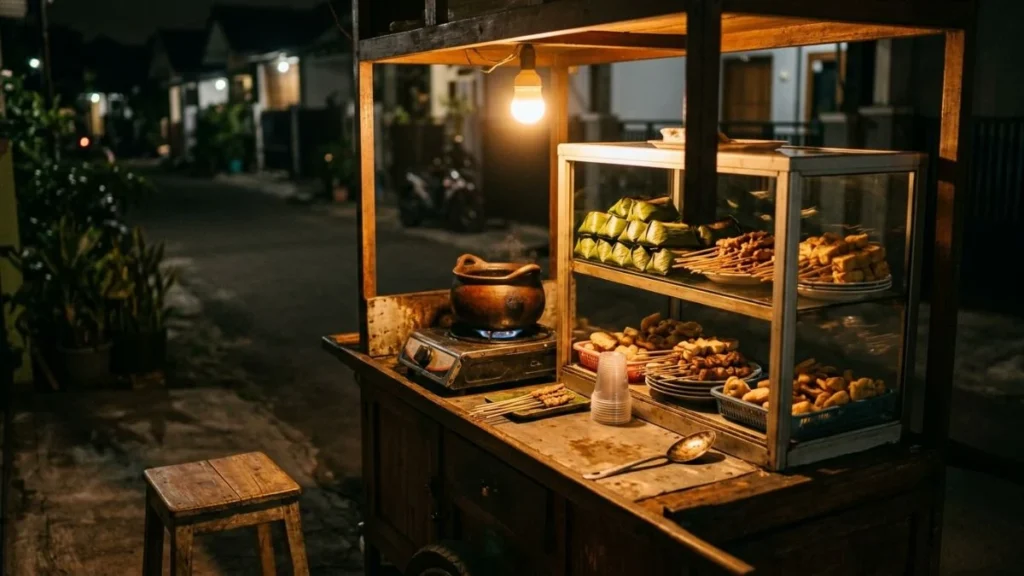
At the warung and angkringan end — the tier covered in more depth in the Yogyakarta food guide — a full meal of rice, protein, and vegetables costs IDR 15,000 to IDR 35,000 (approximately USD 1–2.20). A bowl of soto from a market warung, a portion of gudeg from Wijilan, or an angkringan spread of small rice portions and skewers lands at the lower end of this range. This is how the city eats, and eating this way consistently is one of the most significant budget levers available — a traveler eating three meals a day at this tier spends roughly IDR 50,000 to IDR 100,000 daily on food total.
The mid-range restaurant tier in Prawirotaman and the tourist corridors near Malioboro runs IDR 50,000 to IDR 150,000 per dish — Indonesian and international food, generally solid quality, priced for visitors rather than the local market. A full sit-down meal with drinks at this tier lands at IDR 100,000 to IDR 250,000 per person.
The upper restaurant tier — boutique cafés, heritage restaurant dining, hotel restaurants — runs IDR 150,000 to IDR 400,000 per person for a meal. There are a handful of genuinely good restaurants in this range in Yogyakarta; it’s a smaller category than Bali’s equivalent, which is either limiting or irrelevant depending on how much dining matters to your trip.
Transport: City Movement vs Day Trips
City transport in Yogyakarta is inexpensive by any standard. A ride-hailing motorbike trip across the central area runs IDR 8,000 to IDR 20,000. A car trip of the same distance is IDR 25,000 to IDR 50,000. Daily city transport for a traveler using ride-hailing for most movement typically runs IDR 50,000 to IDR 100,000 total.
Day trips are where transport costs scale significantly. A private car and driver for a full day — the most practical option for Borobudur, Jomblang Cave, or the Merapi highlands — typically runs IDR 400,000 to IDR 700,000 for the vehicle, split across however many travelers share it. Solo travelers absorb this cost fully; two or three travelers splitting it brings the per-person figure into a range comparable to a mid-range restaurant meal.
The Trans Jogja bus covers the Prambanan route for a fraction of the private car cost — IDR 3,500 per trip — making it the most practical budget option for that specific day trip. Other major destinations like Borobudur and Jomblang don’t have equivalent public transport coverage, which means the private car or rented motorbike cost is effectively unavoidable for those routes.
Motorbike rental runs IDR 70,000 to IDR 120,000 per day depending on the bike and how far in advance you arrange it. For travelers doing multiple day trips across several days, renting a motorbike for the full duration is often more economical than arranging private cars per day — the calculation depends on your comfort level with riding and your itinerary density. The getting around Yogyakarta guide covers all the transport options and their honest trade-offs in more detail.
Entry Fees: The Major Sites
Entry fees in Yogyakarta are generally reasonable by international standards, with the notable exception of the premium sunrise ticket at Borobudur.
- Kraton Yogyakarta: IDR 15,000 (general admission) — one of the better-value entry fees in the region given what the site is
- Taman Sari: IDR 15,000 for domestic visitors, IDR 25,000 for foreign visitors — straightforward
- Borobudur: Standard ticket IDR 50,000 for domestic, IDR 350,000–450,000 for foreign visitors; the sunrise ticket tier is significantly higher and varies by season — worth checking the current price before budgeting
- Prambanan: IDR 50,000 domestic, IDR 350,000 foreign visitors; the Ramayana Ballet outdoor performance is a separate ticketed event on top of standard entry
- Jomblang Cave: IDR 500,000 to IDR 800,000 per person depending on operator and season — the most expensive single activity in a standard Yogyakarta itinerary by a significant margin
- Ratu Boko: IDR 40,000 domestic, IDR 250,000 foreign visitors
- Kotagede: No entry fee to the neighborhood; individual workshops vary
Full detail on how Jomblang Cave costs fit into a day that also involves transport and guide fees is covered in that guide — the entry fee is only part of the total spend for that activity.
Putting It Together: Three Daily Budget Ranges
Rather than a single number, here are three honest daily budget ranges that reflect genuinely different travel styles in Yogyakarta:
Budget traveler (IDR 350,000–600,000 / approximately USD 22–38 per day): guesthouse accommodation at the lower end of the mid-range, three meals per day from warungs and angkringan, city transport by ride-hailing and Trans Jogja, one major entry fee. Day trips to Borobudur or Jomblang require additional budget on those specific days.
Independent traveler, mid-range (IDR 700,000–1,400,000 / approximately USD 44–88 per day): comfortable mid-range accommodation, a mix of warung meals and occasional sit-down restaurant, ride-hailing for city transport, and one private car day trip per two to three days split across two travelers.
Comfort traveler (IDR 1,500,000–2,500,000+ / approximately USD 94–156+ per day): boutique or heritage accommodation, regular restaurant dining with occasional upper-tier meals, private car transport for most day trips, and flexibility to book Borobudur sunrise tickets and Ramayana Ballet without treating them as splurges.
For a clear picture of how this maps onto an actual schedule, the 3-day Yogyakarta itinerary covers the daily structure that these budget ranges would be applied to.
Frequently Asked Questions
Is Yogyakarta cheap to visit?
By most international standards, yes — particularly for accommodation and food. A traveler eating at warungs and staying in mid-range guesthouses can cover daily costs at a level that’s significantly cheaper than equivalent travel in Europe, Australia, or North America. The main budget variables are accommodation tier, how many private car day trips you do, and whether you book the premium Borobudur sunrise ticket.
How much spending money do I need per day in Yogyakarta?
A realistic range for independent travelers is IDR 700,000 to IDR 1,400,000 per day (approximately USD 44–88), covering comfortable mid-range accommodation, mixed dining, and city transport. Budget travelers can manage on IDR 350,000–600,000 by eating at warungs and staying in basic guesthouses. Day trips to Borobudur or Jomblang Cave add significantly to daily costs on those specific days.
Is Yogyakarta cheaper than Bali?
Generally yes, particularly for accommodation and food. Yogyakarta doesn’t have Bali’s density of high-end villas and international restaurants, which keeps the upper end of the price range lower and the mid-range more accessible. Transport costs for day trips are comparable once you factor in similar private car rates, though Yogyakarta’s day trip destinations are generally closer to the city center than Bali’s equivalent.
What is the most expensive thing to do in Yogyakarta?
The Borobudur sunrise ticket is among the higher single-activity costs for foreign visitors. Jomblang Cave is consistently the most expensive standard activity on a Yogyakarta itinerary once entry, guide fees, and transport are combined. The Ramayana Ballet outdoor performance at Prambanan during peak season is the other significant ticketed expense worth budgeting for in advance.