Prambanan Temple Yogyakarta is the other temple on every Java itinerary — the Hindu counterpart to Borobudur’s Buddhism, closer to the city, and in some ways easier to visit. What most guides skip is what the site actually rewards, why the smaller temples around it are worth factoring in, and how to avoid the version of Prambanan that’s remembered mostly for heat and crowds.
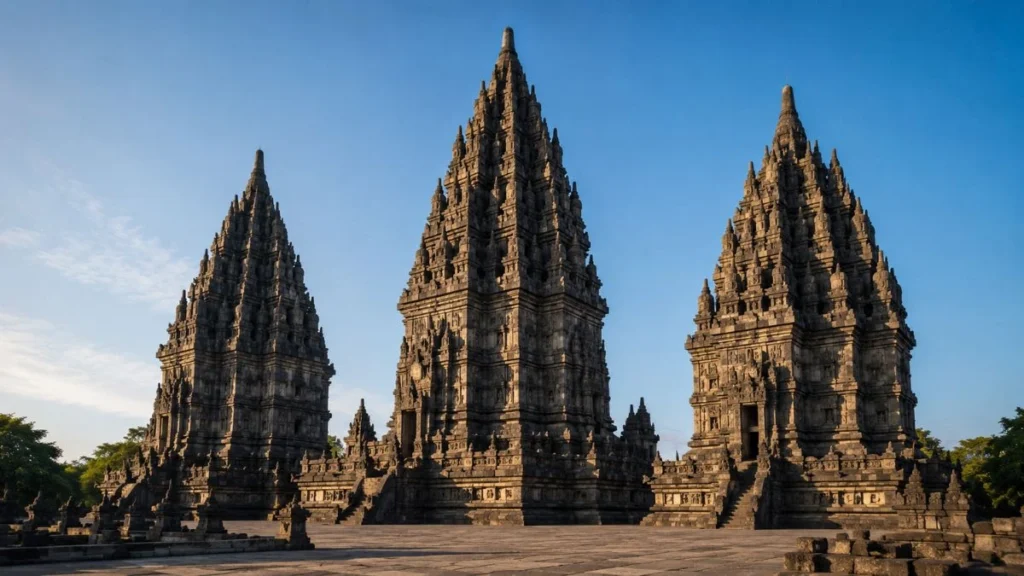
Prambanan Temple Yogyakarta sits about 17 kilometers east of the city center — significantly closer than Borobudur, and reachable without the early start that a Borobudur sunrise visit demands. It’s the largest Hindu temple complex in Indonesia and one of the largest in Southeast Asia, built in the 9th century and dedicated primarily to the Trimurti: Brahma, Vishnu, and Shiva. The three main temples, rising to 47 meters each, are what most photographs show. The surrounding complex has over 200 smaller temples in various states of preservation, most of which visitors walk past without stopping.
What Prambanan Temple Actually Is
Prambanan was built during roughly the same period as Borobudur, a few decades later, under the Sanjaya dynasty — which means the two great temple complexes of the Yogyakarta region were constructed within living memory of each other by competing political and religious powers. That context, rarely mentioned in the brochures, makes the region’s heritage considerably more interesting than two isolated monuments suggest: 9th-century Java was a place where Buddhist and Hindu royal courts were building monumental architecture in parallel, within 40 kilometers of each other.
The Prambanan compound is organized around a central walled yard containing the three main temples — Shiva (the largest), Vishnu, and Brahma — flanked by three smaller temples housing the vehicles of each deity (Nandi the bull for Shiva, Garuda for Vishnu, Hamsa the swan for Brahma). The outer compounds contain hundreds of smaller perwara temples in varying states of reconstruction, many still in pieces following a significant earthquake in 2006 that caused substantial damage across the site.
The Relief Panels: What Most Visitors Walk Past
Prambanan’s relief panels are among the most detailed and narratively rich in Southeast Asia — the main Shiva temple’s inner gallery tells the Ramayana in carved stone, while the Brahma temple continues the story. This is worth knowing before you visit because it transforms the walkthrough from a visual spectacle into something more legible.
Most visitors move through the outer corridors of the main temples without realizing the panels have a sequence — they read clockwise, starting from the east side, and tell a continuous story rather than individual scenes. Spending time following the Ramayana narrative across the Shiva and Brahma temples adds significant depth to a visit and takes perhaps an extra 45 minutes over a purely structural walkthrough.
Ratu Boko: The Natural Pairing Most People Skip
Ratu Boko — the hilltop royal compound we cover separately in the Ratu Boko guide — sits about 15 minutes by road from Prambanan and makes a natural afternoon addition to a Prambanan morning. The two sites cover different periods and different functions: Prambanan is monumental religious architecture at its most ambitious, Ratu Boko is a quieter, more ambiguous royal compound on a hill with views across the plain that produced both sites.
The combination works well precisely because they’re different in atmosphere — Prambanan’s scale and organized visitor flow make Ratu Boko’s quieter, less interpreted character feel like a genuine contrast rather than more of the same. Late afternoon at Ratu Boko after a Prambanan morning is one of the better ways to spend a day in the Yogyakarta region without feeling rushed.
How Prambanan Compares to Borobudur
The most common question for travelers who can only fit one major temple into a Yogyakarta trip is which one to choose. The honest answer depends on what you’re looking for rather than which site is objectively superior.
Borobudur is larger in scale and more dramatically situated, and the upper terraces offer a spatial experience that Prambanan’s ground-level layout doesn’t match. The sunrise ticket, on a clear morning, produces a visual that’s difficult to find elsewhere in Indonesia. The trade-off is distance from Yogyakarta, higher ticket prices for the preferred sunrise slot, and a site that functions on a larger and more managed tourist circuit.
Prambanan is closer to central Yogyakarta, easier to reach independently, and has the Ramayana relief panels that reward careful attention in a way that Borobudur’s exterior stupas don’t. The surrounding complex of smaller temples, and the proximity to Ratu Boko, also makes the eastern temple region feel like a more varied half-day than Borobudur on its own. For travelers staying in Yogyakarta and visiting one temple only, Prambanan’s convenience and the Ratu Boko pairing give it a practical edge for a self-organized day trip.
We cover both options and how to choose between them in the 3-day Yogyakarta itinerary.
Getting to Prambanan from Yogyakarta
Prambanan is close enough to Yogyakarta that it’s one of the few major day trips reachable by public transport without significant inconvenience. The Trans Jogja bus service runs a route from central Yogyakarta to the Prambanan area, making it accessible without a private car — useful for solo travelers or budget-conscious visitors who don’t want to arrange transport separately.
Ride-hailing apps (Gojek and Grab) cover the route reliably from central Yogyakarta — the shorter distance compared to Borobudur means driver supply is more consistent. Private cars or drivers arranged through accommodation are the most convenient option if you’re also planning to continue to Ratu Boko afterward, since the two sites don’t align with the same transport route.
For a full picture of how getting around Yogyakarta works for day trips like this one, the things to do in Yogyakarta guide covers practical transport context alongside the sights.
The Ramayana Ballet: Worth Knowing About Before You Book
Prambanan hosts an outdoor Ramayana Ballet performance on full-moon evenings, staged in front of the illuminated main temple compound. It’s one of the more atmospheric cultural experiences available in the Yogyakarta region — traditional Javanese dance performance telling the same Ramayana story carved in the temple’s relief panels, with the actual temple as backdrop.
The honest caveats: it runs on a specific schedule tied to full-moon dates, not every evening, so it requires planning around. The open-air venue means weather matters — a performance in the dry season is a different experience from one in the wet season. Tickets sell out in advance during peak season. And the performance is long (typically several hours for the full version) — worth knowing before committing to an evening that runs later than most temple visits.
If the date works with your trip, it’s one of the more memorable ways to spend an evening in Yogyakarta. If it doesn’t, the Kraton’s daytime gamelan rehearsals offer a different but equally genuine cultural experience without the scheduling complexity — covered in our Kraton Yogyakarta guide.
Frequently Asked Questions
How far is Prambanan Temple from Yogyakarta?
Prambanan Temple is roughly 17 kilometers east of central Yogyakarta, about 30–45 minutes by car or ride-hailing app depending on traffic.
Is Prambanan or Borobudur better to visit from Yogyakarta?
Both are worth visiting if time allows, but if choosing one, Prambanan’s proximity to Yogyakarta and natural pairing with Ratu Boko gives it a practical edge for a self-organized day trip. Borobudur offers greater scale and the sunrise experience. We cover the full comparison in the 3-day Yogyakarta itinerary.
Can I get to Prambanan from Yogyakarta without a car?
Yes — the Trans Jogja bus service connects central Yogyakarta to the Prambanan area, making it one of the few major day trips from Yogyakarta accessible by public transport. Ride-hailing apps also cover the route reliably given the shorter distance.
What is the Ramayana Ballet at Prambanan?
An outdoor traditional Javanese dance performance staged in front of the illuminated Prambanan temple compound on full-moon evenings, telling the Ramayana story depicted in the temple’s relief panels. It runs on a specific schedule, not every evening, and tickets sell out during peak season.