Last updated: 4 August 2026
Candi Sambisari sat buried under volcanic ash for nearly a thousand years, discovered only when a farmer’s hoe struck stone in the middle of an ordinary field.
Quick Facts
- Built: 9th century, dedicated to Shiva
- Buried: By a Mount Merapi eruption around 1006 AD
- Rediscovered: 1966, by a farmer working his field
- Entrance fee: Free or minimal donation-based
- Time needed: 30–45 minutes
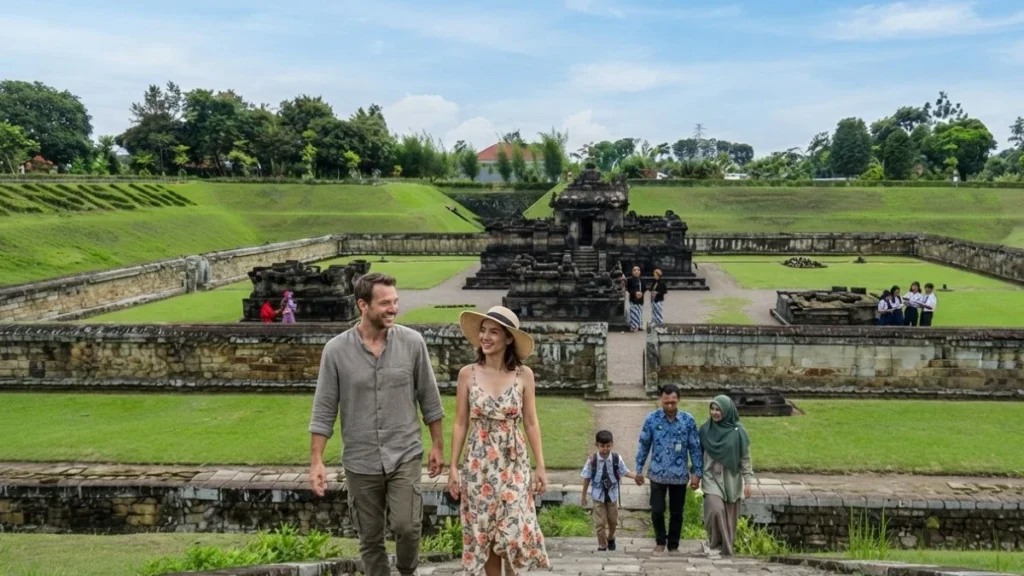
Candi Sambisari is a small 9th-century Hindu temple in Sleman Regency, about 15 kilometers northeast of central Yogyakarta and close enough to borobudur from yogyakarta and prambanan temple yogyakarta that it can easily be folded into the same day. What makes it different from those larger, more famous sites is where it sits — roughly 6.5 meters below the surrounding ground level, inside a sunken courtyard rather than rising up from it.
Buried by the Mountain That Built It
According to the Yogyakarta Tourism Portal, the temple is believed to have been covered by volcanic material from a Mount Merapi eruption around 1006 AD, sealing it beneath sand and ash for centuries. It stayed hidden and unknown until 1966, when a local farmer working his field struck stone with his hoe — a discovery that turned out to be the top of the temple’s central sanctuary.
Excavation eventually removed enough earth to reveal the full complex, leaving the temple sitting in a deep, walled depression rather than at ground level — the direct result of how far down it had been buried.
What’s Inside the Complex
Sambisari’s layout follows classic Javanese Hindu temple design: one main shrine facing west, with three smaller companion temples (perwara) lined up in front of it. The main sanctuary is reached by a staircase flanked by carvings of Makara, mythical creatures from Hindu tradition, and lion sculptures mark the base.
Inside, a lingam and yoni — symbolic representations of Shiva and his consort — occupy the central chamber, while niches on the outer walls hold statues of Durga, Ganesha, and Agastya. The temple is generally believed to have been dedicated to Shiva, based on these carvings and its overall design.
Why It’s Worth the Detour
Unlike Borobudur or Prambanan, Sambisari doesn’t draw large crowds, and that’s part of its appeal. Because it was buried rather than left exposed for a thousand years, its carvings and structure escaped much of the weathering and stone-robbing that affected other Javanese temples still standing above ground — what you’re seeing is close to the original condition rather than a heavily reconstructed approximation.
The sunken setting also creates an unusual visual effect: standing at the rim of the excavation, you look down into the temple courtyard rather than up at a rising structure, with open green fields surrounding the pit on all sides.
Practical Details
- Location: Sambisari village, Purwomartani, Kalasan, Sleman Regency — about 15 km northeast of central Yogyakarta.
- Entrance: Free or minimal cost, making it one of the more budget-friendly temple visits in the region.
- Best time to visit: Early morning or late afternoon, both for cooler temperatures and softer light for photos.
- Time needed: 30–45 minutes is usually enough given the temple’s small scale.
- Pairing it with other stops: Its location near the Yogyakarta–Solo road makes it easy to combine with a Prambanan visit or a stop en route to candi ijo yogyakarta.
Is It Worth Visiting?
For history-minded travelers who’ve already covered the major temples and want something quieter and more unusual, yes — Sambisari offers a genuinely different visual experience for very little time or cost. It’s not a must-see on the level of Borobudur or Prambanan, but as a short, low-effort addition to a temple-focused day, it’s an easy yes.
Is Candi Sambisari free to visit?
Entrance is free or carries only a minimal donation-based fee, making it one of the more accessible temple sites near Yogyakarta.
How long does a visit to Candi Sambisari take?
Given its small size, most visitors spend 30 to 45 minutes exploring the complex.
Can I combine Candi Sambisari with Prambanan in one day?
Yes, its location near the Yogyakarta–Solo road makes it a convenient stop alongside Prambanan or other temples in the area.
Why is the temple below ground level?
It was buried under volcanic ash from a Mount Merapi eruption roughly a thousand years ago; the sunken courtyard visible today is the result of excavating the temple back out of that buried layer.
What is Candi Sambisari dedicated to?
Based on its carvings and the lingam-yoni at its center, the temple is generally believed to have been dedicated to Shiva.
Sumber Resmi
- Yogyakarta Tourism Portal — Candi Sambisari (diverifikasi aktif via fetch, diakses 4 Agustus 2026) — sumber resmi Dinas Pariwisata DIY untuk sejarah penemuan Candi Sambisari