Imogiri Royal Cemetery Yogyakarta is one of the most significant royal burial sites in Java, located about 20 kilometers south of the city. More than a historic landmark, it remains an active place of pilgrimage where traditional rules, restricted access, and local customs are still respected and enforced. Visiting requires more preparation than most attractions in the region, but that authenticity is exactly what makes the experience so rewarding.
Imogiri Royal Cemetery is the kind of site that most Yogyakarta itineraries don’t include because the access logistics are specific — it opens only three days a week, requires visitors to change into traditional Javanese court dress, prohibits cameras inside, and involves climbing approximately 409 steep stone steps to reach the burial complex at the top. None of these constraints are obstacles so much as conditions that shape an experience fundamentally different from walking through a fenced heritage site with an audio guide. Imogiri is a working pilgrimage destination that has been visited continuously since the 17th century, and the atmosphere inside reflects that without apology.
What Imogiri Actually Is
The Imogiri Royal Cemetery was built between 1632 and 1640 by Sultan Agung Hanyokrokusumo, the third Sultan of Mataram, who chose the hilltop site in what is now Bantul Regency as the royal burial ground for himself and his descendants. The 10-hectare burial complex houses the burials of the kings who once reigned under the Kasunanan Surakarta and the Sultanate of Yogyakarta, along with their families.
The site’s organization reflects the political history of the Mataram Sultanate, which split in 1755 into the Yogyakarta and Surakarta (Solo) courts through the Treaty of Giyanti. The three sultanates’ burial grounds are located in three different zones: Sultan Agung Mataram’s family graveyard is on the top, Surakarta is in the west, and Yogyakarta is in the east. This means Imogiri is simultaneously the sacred site of both royal courts that govern Java’s two main cultural centers — an arrangement that has no real equivalent elsewhere in Indonesia.
The name Imogiri derives from the Sanskrit Himagiri, meaning “mountain of snow” — another name for the Himalaya — which gives some sense of the spiritual ambition behind the site’s placement on a prominent hilltop rather than on accessible flat ground.
The 409 Steps: What the Climb Involves
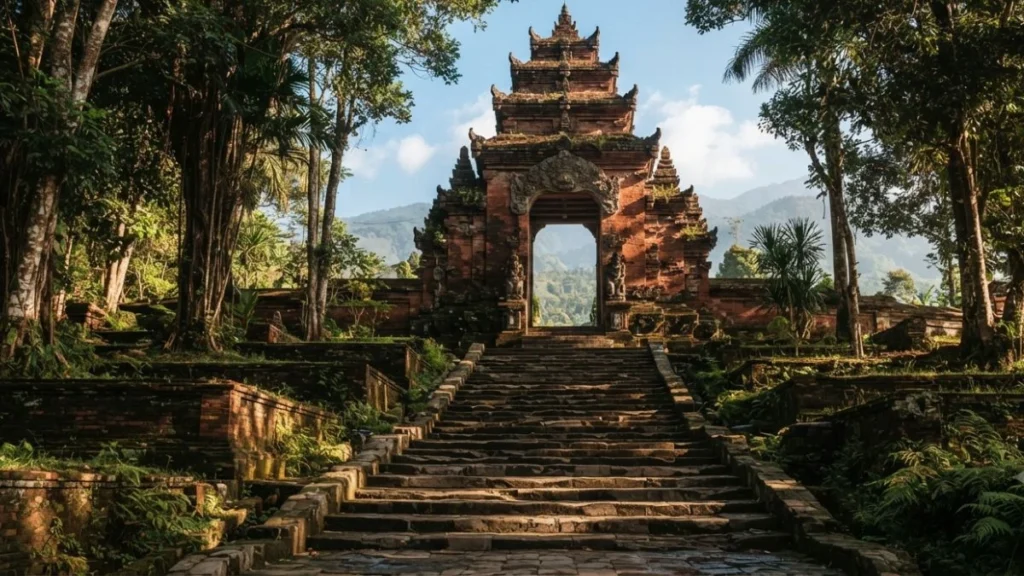
Reaching the inner complex requires climbing 409 steep stone steps, angled almost 45 degrees. This is not metaphorical — the staircase is genuinely steep, the stone is worn smooth in places by centuries of pilgrims, and the climb in Yogyakarta’s heat takes real effort. Most visitors take 20 to 30 minutes to ascend, with stops.
The climb is the first way Imogiri differs from most heritage sites in the region: it asks something physical of you before you arrive. The effort has its own meaning in the pilgrimage context — the cemetery was built on a difficult-to-reach hilltop deliberately, and the ascent is part of the experience rather than an unfortunate logistical detail. Arriving at the top having made the climb produces a different relationship to the place than stepping off a bus into a fenced compound.
Wear closed-toe shoes with grip for the steps. Remove footwear before entering the inner sanctuary areas — this is required, not optional, and the stone can be worn and uneven underfoot.
The Mandatory Dress Code
Visitors must wear traditional attire provided by the palace attendants, available for rent for around Rp20,000. The dress requirement applies to all visitors regardless of nationality and is enforced at the entrance — you cannot enter the inner areas without changing.
For male pilgrims the attire consists of Javanese clothes including blangkon (traditional headwear), beskap (formal jacket), cloth sarong, belt, timang and samir. For female pilgrims it is a kemben (traditional top) and long cloth. The palace attendants at the entrance assist with dressing and are patient with visitors unfamiliar with how the pieces go together.
The dress requirement is genuinely part of what makes an Imogiri visit different from any other Yogyakarta experience — entering a sacred royal burial complex in Javanese court dress rather than tourist clothes shifts the register of the visit in a way that matters. Several visitors who’ve written honestly about the site note that they expected to feel self-conscious and instead found the dressing process unexpectedly moving.
Photography is prohibited inside the inner areas — the strict rules regarding photography and attire are in place to preserve the sanctity of the site. Photograph the approach, the gates, the hillside setting before you enter. Inside, put the camera away.
Opening Hours: The Critical Practical Detail
The graves open to the public three times a week: Monday morning (generally the quietest time), Friday afternoon, and Sunday morning. Imogiri is closed during the Muslim month of Ramadan.
It is open every Monday (10 AM), Friday (1 PM) and Sunday (10 AM).
This is the most important practical fact about Imogiri and the one most frequently missed by visitors who arrive on a Tuesday or Wednesday and find the gates closed. Planning a visit around the three open days is non-negotiable — unlike most Yogyakarta sites, Imogiri cannot be visited spontaneously on any day of the week.
Monday morning is the recommended visit slot for most independent travelers: Monday morning is generally the quietest time, with fewer pilgrims and domestic tourists than Sunday. Friday afternoon opens after midday prayer, which means a shorter visiting window. Sunday brings the largest visitor numbers of the three open days.
The Sacred Water Vessels
Visitors can see four barrels or padhasan in the cemetery. These barrels have different names: Gentong Nyai Siyem from Siam, Gentong Kyai Mendung from Rum (Turkey), Gentong Kyai Danumaya from Aceh, and Gentong Nyai Danumurti from Palembang. These barrels are said to have properties for health, healing or success, and many believing pilgrims seek water from these barrels.
The four vessels — diplomatic gifts from neighboring kingdoms to Sultan Agung, according to the site’s oral history — are one of the more unusual features of the complex and one of the few elements that non-Javanese visitors can engage with directly. The line of pilgrims waiting to receive water from the vessels, the abdi dalem (palace servants) who manage the site, and the overall atmosphere of active pilgrimage rather than passive heritage tourism combine to make this genuinely unlike most things available to visitors in the region.
What the Visit Actually Feels Like
The honest description from visitors who’ve gone specifically as travelers rather than pilgrims: the interior of the Sultan Agung mausoleum is dark, hot, and intensely atmospheric. The visit is solemn — visitors are invited to remain silent, and the interior of the mausoleum of Sultan Agung is dark and very hot. There is definitely a spiritual side to this visit.
The abdi dalem — the hereditary palace servants who maintain the site and guide visitors — have often served the cemetery for decades and carry knowledge of the site’s history and spiritual significance that no guidebook replicates. Engaging with them, particularly if you have Indonesian language basics from the Javanese language basics guide, produces a different experience from moving through the space independently.
How Imogiri Connects to the Rest of Yogyakarta
Imogiri’s position in the cosmological framework of the Yogyakarta sultanate connects directly to what the Kraton Yogyakarta guide describes about the living court culture — the same institution that holds morning gamelan rehearsals in the Kraton pendopo maintains Imogiri as the burial ground of its predecessors, and the abdi dalem at Imogiri are part of the same palace service structure as those at the Kraton itself.
The Labuhan ceremony described in the Kraton ceremonies guide — the ritual offerings sent to Merapi and the sea — connects to the same cosmological axis that places Imogiri to the south as the third point of Yogyakarta’s spiritual geography: Merapi to the north, the Kraton at the center, Imogiri and then the Indian Ocean to the south.
The Javanese culture and etiquette guide covers the broader value framework that makes Imogiri comprehensible — the Javanese reverence for ancestors, the relationship between the royal courts and the spiritual landscape, and the way pilgrimage to the graves of the sultanate’s founders functions as a living practice rather than a historical curiosity.
For the wider picture of Yogyakarta’s off-the-beaten-path sites, the things to do in Yogyakarta guide covers what Imogiri sits alongside in a broader regional visit.
Getting There From Yogyakarta
Imogiri is approximately 20 kilometers south of central Yogyakarta. Getting there by public transport is fiddly: catch a city bus to the Giwangan Terminal and then pick up a bemo minibus. For most independent visitors, a rented motorbike or private car is significantly more practical — the road south from Yogyakarta through Bantul to Imogiri is straightforward and well-marked.
The getting around Yogyakarta guide covers the motorbike rental and private car options. Journey time from central Yogyakarta is approximately 30 to 40 minutes by motorbike or car.
Imogiri pairs naturally with a Parangtritis or Parangkusumo beach visit to the southwest — both are in the same general direction from Yogyakarta and can be combined into a half-day without significant backtracking.
Frequently Asked Questions
When is Imogiri Royal Cemetery open?
Imogiri opens three days per week: Monday at 10am, Friday at 1pm (after Friday prayers), and Sunday at 10am. It is closed during Ramadan. Confirming current hours before visiting is advisable, as occasional closures for ceremonies or maintenance occur.
Do I have to wear traditional dress at Imogiri?
Yes — traditional Javanese court dress is mandatory for all visitors entering the inner cemetery areas and is not optional. The attire is available for rent at the entrance for approximately Rp15,000–20,000. The palace attendants assist with dressing, and the process takes around 10 minutes.
Can I take photos inside Imogiri Royal Cemetery?
Photography is prohibited inside the inner areas of the complex. Cameras and phones should be put away before entering the inner sanctuary. Photographing the exterior, the approach staircase, and the surrounding hillside landscape is permitted.
How difficult is the climb at Imogiri?
The staircase involves approximately 409 steep steps angled at close to 45 degrees. The climb takes most visitors 20 to 30 minutes with stops, and is physically demanding in Yogyakarta’s heat. Wear shoes with grip and bring water for the ascent.