Kraton ceremonies Yogyakarta are the most direct expression of living Javanese court culture available to any visitor — not reconstructed heritage, not museum display, but actual ceremonial events that happen on a calendar because the institution that produces them is still functioning. Knowing which ceremonies exist, when they happen, and what they actually involve is the difference between visiting the Kraton as a historical site and visiting it as a living one.
Kraton ceremonies Yogyakarta follow two overlapping calendars — the Islamic calendar and the traditional Javanese calendar (the Pawukon cycle and the Javanese-Islamic Aboge calendar) — which means the dates of most ceremonies shift relative to the Gregorian calendar from year to year. This is the first practical thing to understand: unlike a cultural performance with a fixed weekly schedule, the Kraton’s ceremonial calendar requires checking the actual dates for the year of your visit rather than assuming a ceremony will happen during a particular Gregorian month. The effort is worth making because several of these ceremonies are among the most visually remarkable and culturally significant events accessible to visitors anywhere in Indonesia.
Grebeg: The Three Annual Processions
Grebeg is the most significant recurring ceremony in Yogyakarta’s court calendar — held three times a year corresponding to three major Islamic holidays — and the most accessible to visitors in terms of both scale and public visibility.
Grebeg Maulud marks the Prophet Muhammad’s birthday (Maulid Nabi), occurring in the Islamic month of Rabi’ul Awwal. In Yogyakarta, this ceremony is embedded within the larger Sekaten festival (covered separately below) and is considered the most elaborate of the three Grebeg occasions.
Grebeg Syawal marks the end of Ramadan (Idul Fitri). The ceremony typically occurs on the morning of the first day of Syawal, making it one of the few Kraton ceremonies that falls within the most significant Islamic holiday period when the city is already at its most festive.
Grebeg Besar marks Idul Adha (the Islamic feast of sacrifice), occurring in the Islamic month of Dhul Hijjah.
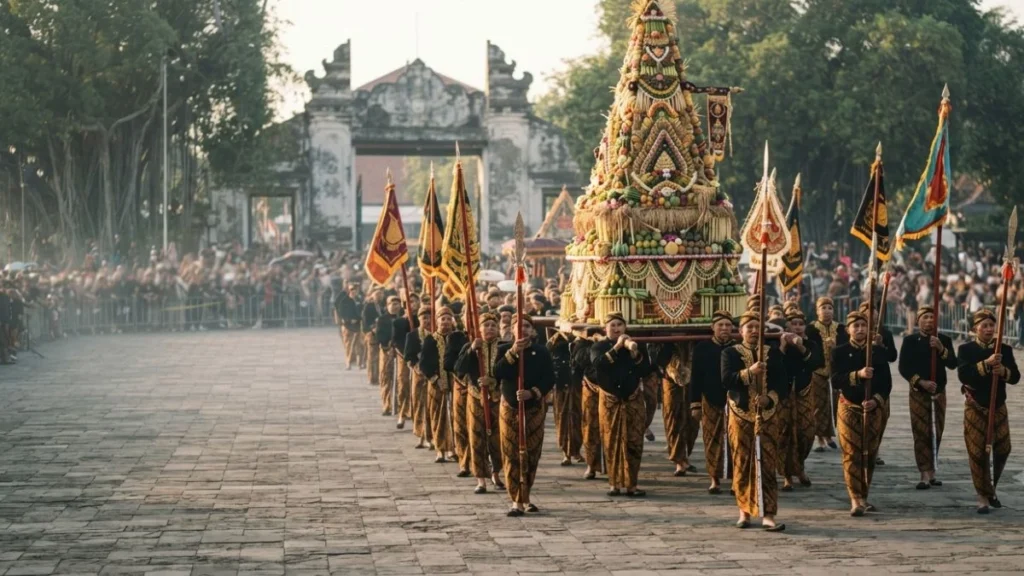
The ceremony itself centers on the gunungan — ceremonial mountains of food, typically formed from rice, vegetables, and other produce, sculpted into an ornate conical shape representing the cosmic mountain of Javanese cosmology. The gunungan are processed from the Kraton through the city to the Grand Mosque (Masjid Gedhe Kauman) in a formal royal procession involving palace guards in traditional court dress, court officials, and gamelan music. Upon arrival at the mosque, the gunungan are blessed by Islamic officials and then dispersed to the crowd — the scramble for pieces of the blessed food is one of the more chaotic and photogenic sequences of the ceremony, with locals believing that the blessed food brings good fortune.
The processional route from the Kraton’s northern gate (Regol Brojonolo) through the northern square (alun-alun utara) to the Grand Mosque is publicly accessible — visitors can stand along the route and watch the procession pass without purchasing tickets or registering in advance. Arriving early enough to secure a position along the route (at least an hour before the procession begins) makes the difference between seeing the ceremony clearly and watching it from behind the crowd.
Sekaten: The Week-Long Festival Before Grebeg Maulud
Sekaten is a week-long festival preceding Grebeg Maulud — the most sustained public ceremonial event in Yogyakarta’s annual calendar and one of the oldest continuous traditions associated with the Yogyakarta Sultanate.
The festival’s origins predate the current sultanate and connect to the period of Java’s Islamization in the 15th and 16th centuries, when the gamelan music played during the week was understood as a vehicle for spreading Islamic teaching to Hindu-Buddhist Javanese communities. The specific gamelan sets used for Sekaten — the Kiai Guntur Madu and Kiai Nogowilogo gamelans, housed in the Kraton and played only during this festival — are among the most sacred objects in the palace collection and are moved to the Grand Mosque compound for the week of Sekaten, where they’re played continuously during the days.
The Sekaten fair that grows up around the festival in the alun-alun utara and surrounding areas is a contemporary addition to the ancient ceremony — a large, chaotic, deeply local fair selling traditional Javanese snacks, crafts, carnival rides, and street food of every description. It has almost nothing to do with the spiritual dimensions of Sekaten and everything to do with how Yogyakartans actually celebrate — the combination of sacred ceremony and enthusiastic public fair is characteristic of how Javanese court tradition and community life have always coexisted.
For visitors timing a Yogyakarta trip around cultural events, Sekaten week followed by Grebeg Maulud is the single richest window for ceremonial and public culture. The trade-off is that accommodation fills up and prices rise significantly during this period.
Labuhan: The Royal Offering to Merapi and the Sea
Labuhan is a ceremony less known to visitors than Grebeg but in some ways more revealing of the cosmological dimensions of the Yogyakarta sultanate — the ritual offering of royal goods to Mount Merapi to the north and to the Indian Ocean to the south, maintaining the spiritual axis that Javanese cosmology places the Kraton within.
The ceremony occurs on significant dates in the Javanese calendar connected to the reigning sultan’s birth and coronation anniversaries, and involves royal officials carrying offerings — traditionally including items from the sultan’s personal effects, food, and ritual objects — to the slopes of Merapi and to the beach at Parangkusumo on the south coast.
The Merapi offering specifically is conducted at a site on the mountain’s slopes, and the connection to the spiritual relationship between the sultanate and the volcano is the most direct expression in ceremonial form of what the Mount Merapi Yogyakarta guide describes in historical and cultural terms. The ceremony at Parangkusumo connects to the legend of Nyai Roro Kidul, the Queen of the South Sea, who is considered to have a mystical relationship with the Yogyakarta sultanate — a tradition that persists in ceremonial form and in the palace’s southern orientation.
Labuhan is less publicly accessible than Grebeg — the ceremony at Merapi’s slopes is in restricted areas, and the beach ceremony at Parangkusumo is more remote — but the dates and public access points are worth checking through the Kraton’s official communications if your visit timing overlaps.
Tumplak Wajik: The Rice Cake Ceremony Before Grebeg
Tumplak Wajik is a smaller ceremony held approximately two days before each Grebeg, marking the formal preparation of the gunungan — the moment when the royal kitchen begins assembling the ceremonial food mountains. It’s conducted within the Kraton’s inner palace precincts, involves gamelan music and specific ceremonial preparation, and is visible to visitors from the public areas of the Kraton compound.
For visitors who are in Yogyakarta in the days preceding a Grebeg, Tumplak Wajik is worth knowing about as a quieter version of the ceremonial sequence — smaller in scale than the Grebeg procession but more intimate and less crowded, with the Kraton’s ceremonial kitchen and preparation areas briefly visible in operation.
Practical Planning for Kraton Ceremonies
Finding the dates: The Kraton publishes its ceremonial calendar, but the dates require calculation against the Islamic calendar rather than the Gregorian calendar for the Islamic-cycle ceremonies. Several Indonesian cultural calendar websites convert between calendar systems and list ceremony dates for the current year. The Indonesian Ministry of Tourism also publishes cultural event calendars that include Grebeg dates. Searching for the specific year’s Grebeg and Sekaten dates is the most reliable approach.
Photography considerations: The Grebeg procession is publicly photographable from the processional route. The interior ceremonies within the Kraton compound require more care — the Yogyakarta photography guide covers the etiquette framework, and the Javanese culture guide covers the broader respect context. Using a long focal length from a respectful position rather than pushing into the ceremonial space is the consistent recommendation.
What to wear: Grebeg procession viewing from the street requires no special dress. Entering the Kraton compound for any ceremony requires the covered shoulders and knees appropriate for all Kraton visits. The crowds around ceremony routes are dense — keeping bags secure and being aware of the crowd dynamics is the practical safety consideration.
For the full context of the Kraton as a living institution and what makes it worth visiting beyond the ceremonial calendar, the Kraton Yogyakarta guide covers the day-to-day visit. The gamelan music guide covers the musical tradition that runs through all of these ceremonies. The wayang kulit guide and Ramayana Ballet guide cover the performing arts traditions that often accompany ceremonial periods.
Frequently Asked Questions
When is Grebeg in Yogyakarta?
Grebeg occurs three times a year on dates determined by the Islamic calendar: Grebeg Maulud (Prophet’s birthday, Rabi’ul Awwal), Grebeg Syawal (end of Ramadan, first of Syawal), and Grebeg Besar (Idul Adha, Dhul Hijjah). The Gregorian calendar dates shift annually — checking the specific year’s dates through Indonesian cultural calendar resources is necessary for trip planning.
Can visitors watch Kraton ceremonies in Yogyakarta?
Yes — the Grebeg procession passes through public streets and the alun-alun utara, making it publicly viewable without advance registration or tickets. The ceremony within the Kraton compound itself has varying access depending on the specific ceremony and the day. Checking with the Kraton directly or through your accommodation for current access information before attending is recommended.
What is Sekaten in Yogyakarta?
Sekaten is a week-long festival preceding Grebeg Maulud, centered on the playing of the Kraton’s sacred gamelan sets in the Grand Mosque compound. It is accompanied by a large public fair in the northern square. Sekaten is one of Yogyakarta’s most significant annual cultural events and involves both ceremonial religious dimensions and a very large public celebration.
How do I find out about upcoming Kraton ceremonies during my visit?
Your accommodation in Yogyakarta is often the most practical source for current ceremony dates and visitor access information. Indonesian cultural calendar websites listing Javanese and Islamic calendar dates for the current year provide the ceremony dates; the Kraton’s own communications or the official tourism information in Yogyakarta provide access details.