Ratu Boko sits on a hill fifteen minutes from Prambanan, gets a fraction of its visitors, and offers a version of Yogyakarta’s temple heritage that’s harder to find at the bigger sites — one where you can actually stand somewhere quiet and think. Most people drive straight past it. That’s worth reconsidering.
Ratu Boko is one of those sites that keeps coming up whenever the conversation turns to things to do in Yogyakarta beyond the obvious circuit — and then gets left off the actual itinerary anyway, because Borobudur and Prambanan are easier to justify to anyone who asks how you spent your time. This guide is for the version of the trip where you’ve already made peace with doing fewer things more slowly.
What Ratu Boko Actually Is
Ratu Boko isn’t a temple in the conventional sense — which is partly why it tends to get skipped in favor of Borobudur and Prambanan, both of which offer the clearly defined “ancient temple” experience most visitors come to Central Java expecting. Ratu Boko is better understood as a royal compound: a hilltop complex of gates, pavilions, bathing pools, and ceremonial spaces believed to have functioned as a palace or retreat for a Javanese ruler sometime between the 8th and 9th centuries.
The name “Ratu Boko” translates loosely to “stork king,” a reference from local legend rather than any historical record — the site’s actual origins and the civilization that built it remain partially uncertain, which is either a frustration or an interesting ambiguity depending on your tolerance for incomplete history. What’s clear is that the compound changed hands and religious affiliations over time, incorporating both Hindu and Buddhist architectural elements, which makes it an unusual artifact of the transitional period in Javanese history when the two traditions coexisted.
Why It’s Worth the Detour From Prambanan
The practical case for Ratu Boko comes down to two things: atmosphere and crowds. Prambanan is a genuinely impressive site, but it’s also a well-managed large-scale tourist operation — ticketed entry points, paved pathways, organized visitor flow, tour group timing. Ratu Boko, fifteen minutes up the hill, draws far fewer visitors and has a fundamentally different character as a result.
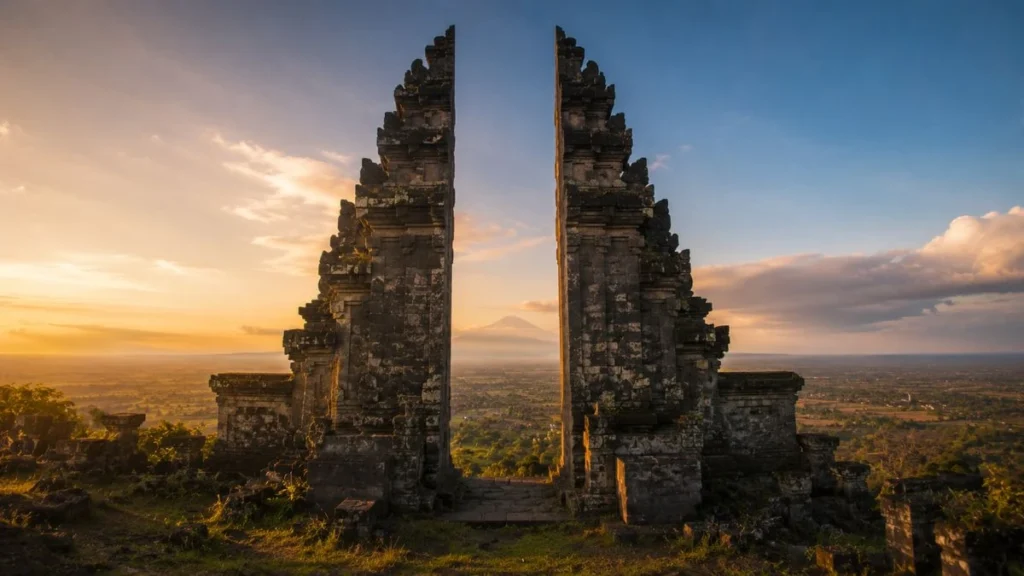
The main gateway structure, a dramatic multi-tiered stone gate that’s become the site’s most photographed element, frames views across the Prambanan plain that are difficult to find elsewhere in the region. Late afternoon, when the light drops low enough to catch the stonework, is the easiest time to photograph this without crowds. It’s also simply a good time to be somewhere elevated and quiet after a morning of busier sites.
The bathing pools in the eastern section of the compound, less prominently marked than the main gate, are worth finding — they read like a smaller, less restored echo of Taman Sari and are often overlooked even by the visitors who do make it up the hill. We cover Taman Sari Water Castle in more detail separately, but the parallel between the two sites — royal bathing complexes from overlapping eras — is the kind of connection that a faster itinerary doesn’t leave room to notice.
How Ratu Boko Fits Into a Yogyakarta Trip
The most natural way to include Ratu Boko is as an addition to a Prambanan afternoon rather than a standalone trip — the two are close enough that combining them into one day is straightforward, with Prambanan in the morning and Ratu Boko in the late afternoon when the light is better and the site is quieter. Trying to add Borobudur to the same day is where the timing starts to fall apart.
In our 3-day Yogyakarta itinerary, we suggest choosing between Borobudur and Prambanan rather than trying to do both in one day — Ratu Boko fits as a natural add-on to the Prambanan option without extending the day unreasonably. If you’re spending four or more days in Yogyakarta, it’s worth treating as its own afternoon rather than squeezing it alongside something else.
For context on how Ratu Boko fits alongside the rest of what Yogyakarta has to offer, the main things to do in Yogyakarta guide covers the full picture.
The Honest Trade-Off
Ratu Boko rewards a certain kind of visit — unhurried, comfortable with partial history and incomplete signage, more interested in atmosphere than clear narrative. The on-site interpretation is limited compared to Prambanan, which means visitors who want context need to do some reading beforehand rather than relying on the site itself to explain what they’re looking at.
For travelers who specifically want the dramatic scale and clear historical narrative of a major Buddhist or Hindu monument, Prambanan and Borobudur are better suited. Ratu Boko is the better choice for travelers who want a quieter, more ambiguous site — the kind of place that asks more of you but gives something different in return.
Frequently Asked Questions
Is Ratu Boko worth visiting from Yogyakarta?
Yes, particularly for travelers who prefer quieter sites and aren’t looking for the scale of Borobudur or Prambanan. The hilltop setting and late-afternoon atmosphere make it worth the detour, especially if paired with a Prambanan visit.
How far is Ratu Boko from Yogyakarta?
Ratu Boko is roughly 18 kilometers southeast of central Yogyakarta, about 30–40 minutes by car or ride-hailing app. It sits approximately 15 minutes by road from the Prambanan temple complex.
What’s the best time to visit Ratu Boko?
Late afternoon is generally best — the light catches the stonework well, crowds are thinner than at midday, and the views across the Prambanan plain are easier to appreciate without the midday haze. Sunset from the main gate area is a common draw, though timing depends on season.
Can I visit Ratu Boko and Prambanan on the same day?
Yes, and this is the most practical way to include both. Prambanan in the morning and Ratu Boko in the afternoon is a manageable combination without feeling rushed.