Last updated: 4 August 2026
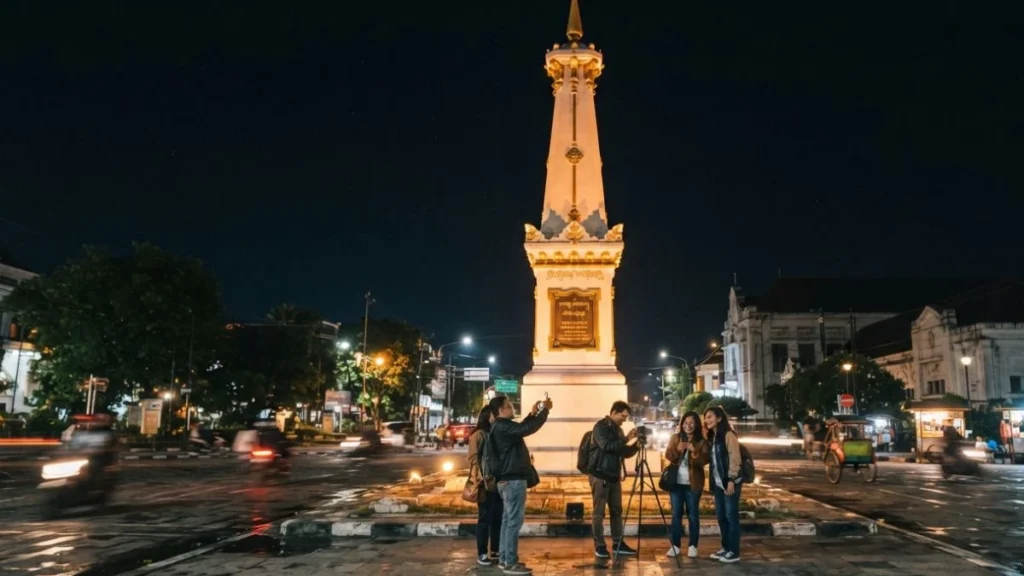
Tugu Jogja sits at one of the busiest intersections in the city, and almost every visitor snaps a photo of it without knowing what it actually represents.
Quick Facts
- Entrance fee: Free, open traffic circle with no set hours
- Best time to visit: Early morning or after dark
- Original built: As Tugu Golong-Gilig, destroyed by an 1867 earthquake
- Rebuilt: 1889 by the Dutch colonial government, in its current squared design
- Nearest landmark: Tugu Station, a short walk away
Tugu Jogja — also called Tugu Pal Putih or the Yogyakarta Monument — is the white obelisk standing in the middle of the crossroads where Jalan Mangkubumi, Jalan Jenderal Sudirman, Jalan AM Sangaji, and Jalan Diponegoro all meet. It’s not a temple or a museum, and there’s no ticket to buy. Most people see it from a moving car or a becak on the way to Malioboro. But the monument carries more symbolic weight than its size suggests.
What Tugu Jogja Actually Represents
The monument marks a point on what’s often described as Yogyakarta’s imaginary axis — a straight line believed to connect the southern sea, the Kraton (Sultan’s Palace), and Mount Merapi to the north. According to the Yogyakarta Tourism Portal, the monument was originally built as a meditation reference point for the Sultan, who used it to align his focus toward Merapi.
It wasn’t always the shape it is today. The original monument, known as Tugu Golong-Gilig, was a cylindrical pole with a rounded top — its shape a physical expression of unity between the ruler and the people (manunggaling kawula gusti). That version stood until an 1867 earthquake destroyed it.
Why It Looks Different From the Original
The Dutch colonial government rebuilt the monument in 1889 with a noticeably different design: a squared base, inscriptions on each side, and a cone-shaped top instead of the original rounded one. It was also shorter than the original — a change some accounts frame as a deliberate move to dilute the unity symbolism the old design carried. The name Tugu Pal Putih (White Pillar Monument) comes from this rebuilt version, and it’s the one still standing today.
Why Locals Treat It as a Milestone
Tugu Jogja has picked up a life beyond its history. Yogyakarta is one of Indonesia’s biggest student cities, home to Gadjah Mada University and dozens of other campuses, and a tradition has grown around the monument: graduating students come here to touch or embrace it as a send-off ritual before leaving the city. It’s become less a historical relic and more a shared marker of finishing a chapter in Jogja — not unlike the nightly ritual at alun-alun kidul, another spot where local tradition has grown around a simple physical landmark.
Visiting Tugu Jogja
There’s no entrance fee and no set hours — it sits in an open traffic circle, visible day or night. A few practical notes:
- Best time to visit: Early morning or after dark, when traffic thins out and the monument is lit up.
- Getting there: It’s a short walk or quick GoJek/Grab ride from malioboro street yogyakarta, and close to Tugu train station, which shares the name.
- What’s nearby: Cafes, souvenir shops, and small eateries cluster around the intersection, making it easy to pair a stop here with a longer walk through the surrounding streets.
- Photography: Because it sits in the middle of an active intersection, getting a clean photo means timing it with a break in traffic — locals often just take the shot quickly from the sidewalk rather than trying to stand at the base, similar to the timing tips in the yogyakarta photography guide.
Is It Worth a Special Trip?
On its own, probably not — it’s a five-minute stop, not a destination. But since it sits so close to Malioboro and Tugu Station, it’s an easy add-on to a walk through the city rather than something that needs its own slot in an itinerary.
Is there an entrance fee for Tugu Jogja?
No. It’s a public monument in an open traffic circle, free to view at any time.
Why do students hug the monument?
It’s an unofficial local tradition — graduating university students visit Tugu Jogja to mark the end of their time studying in the city before heading home or moving on.
Is Tugu Jogja the same as Tugu Station?
They’re related by location, not identity. Tugu Station (Stasiun Tugu) is Yogyakarta’s main train station, named for its proximity to the monument, but they’re two separate landmarks a short walk apart.
How long does a visit take?
Most people spend 10–15 minutes here, mainly for photos, before continuing on to Malioboro or elsewhere nearby.
Why was Tugu Jogja rebuilt with a different shape?
An 1867 earthquake destroyed the original rounded pillar, and the Dutch colonial government’s 1889 reconstruction used a squared, cone-topped design — the version still standing today.
Sumber Resmi
- Yogyakarta Tourism Portal — Tugu Jogja (diverifikasi aktif via fetch, diakses 4 Agustus 2026) — sumber resmi Dinas Pariwisata DIY untuk sejarah dan makna simbolis Tugu Jogja