Sonobudoyo Museum Yogyakarta is the kind of place that rewards visitors who arrive with some context and frustrates those who expect a polished international museum experience. It holds the second-largest cultural collection in Indonesia after the National Museum in Jakarta, contains 1,200 keris from across the archipelago, and runs wayang kulit performances most evenings — and yet most Yogyakarta itineraries skip it entirely. Here’s what it actually contains and why it’s worth your time.
Sonobudoyo Museum Yogyakarta sits immediately north of the Kraton complex, just off the alun-alun utara, making it one of the most geographically convenient cultural visits in the city. The proximity is not accidental — the museum was inaugurated on November 6, 1935 by Sri Sultan Hamengkubuwono VIII on his birthday, under the auspices of the Yogyakarta Sultanate, on land originally gifted by the Sultan himself. The collection that fills it wasn’t assembled by Dutch colonial administrators but by Javanese intellectuals and nobility who recognized that the region’s cultural artifacts were at risk of leaving the archipelago entirely.
What Sonobudoyo Museum Yogyakarta Actually Contains
The collection scale surprises most first-time visitors. With more than 63,000 collected objects, the museum presents a journey through time that combines historical, artistic, and Javanese spiritual values — from wayang kulit and keris to masks and gamelan, each collection teaches the philosophy of life and the cultural elegance passed down across generations.
The museum has the second most complete collection of cultural artifacts after the central museum in Jakarta, which is the most practically useful fact for visitors to know in advance — this is not a minor regional collection but a serious institutional archive, and moving through it properly takes more time than most visitors allow.
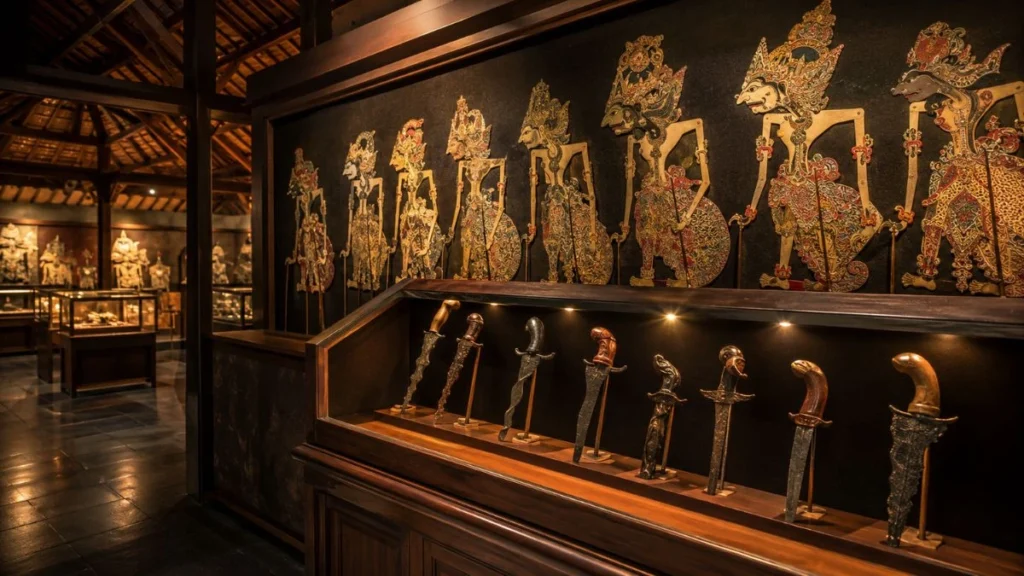
The collection is organized across dedicated rooms: a wayang room housing hundreds of shadow puppets in different styles and periods; a weapons room anchored by the keris collection; a batik room tracing the textile’s regional variations; a ceramics and archaeology room covering the span from Neolithic to the classical Hindu-Buddhist period; and a mask collection that spans Javanese, Balinese, and Madurese traditions.
The keris collection is one of the most significant in the world in terms of breadth. The museum has a complete collection of keris — around 1,200 of them, coming from various regions such as Java, Aceh, Bali, Sulawesi, and Kalimantan. The keris is not merely a weapon in Javanese culture but a spiritually charged object believed to carry its own character and power — understanding this before walking through the weapons room makes what you’re looking at considerably more interesting than a display of historical blades.
The gamelan collection in the front pavilion includes two sets — one carved set that comes from the Cirebon palace, and another from the Yogyakarta palace — which immediately establishes the court connection that runs through the entire museum.
The History Behind the Collection
The Java Instituut was a foundation established in 1919 in Surakarta for the study of the cultures of Java, Madura, Bali, and Lombok. In 1924, the Java Instituut held a congress in Surakarta to establish a museum in Yogyakarta. In 1929, the collection of cultural data from these regions began.
Construction commenced in 1934, incorporating traditional Javanese elements such as joglo roofs and a gate in the “Semar Tinandu” form, reflecting architect Ir. Th. Karsten’s approach to blending indigenous architecture with functional needs. The building’s architecture draws from the Kasepuhan Mosque in Cirebon as well as Javanese court architecture — the result is a building that feels like a continuation of the Kraton’s spatial logic rather than a European museum transplanted to Java.
What distinguishes Sonobudoyo’s founding from most colonial-era museums is the agency behind it. It was founded in November 1935 under the Dutch colonial administration but driven by the earnest efforts of Java’s own intellectuals and nobility. The main goal of its establishment was to preserve and showcase the rich Javanese culture and artifacts that were otherwise being taken to other countries or were at risk of deterioration. This context matters for how the collection reads — these objects were gathered specifically to stay in Java, not to represent Java to an external audience.
The Evening Wayang Kulit Performances
The aspect of Sonobudoyo that most visitors learn about separately rather than planning for: the traditional wayang kulit shadow puppet performance is held regularly in the evenings, with tickets priced at IDR 50,000 for regular seats and IDR 100,000 for VIP.
The performances at Sonobudoyo are the most consistently accessible wayang kulit option in Yogyakarta for visitors without local contacts who could direct them to community performances. They’re shorter than a traditional overnight performance — typically running one to two hours rather than until dawn — but use live gamelan accompaniment and genuine dalang performance rather than a recorded or abbreviated demonstration.
The wayang kulit guide covers the full tradition in depth, including what the different characters mean and how to follow the story. Visiting the museum’s puppet collection during the day before attending an evening performance is the most coherent way to experience both layers — you see the objects in the collection and then watch them in use the same day.
What the Museum Does Well and Where It Falls Short
The honest version: Sonobudoyo is a serious museum with a world-class collection and uneven presentation. The vast collections are impressive, with good insight and explanation, very well-categorized and well-designed displays in some sections. The earlier part of the museum is a bit too dark and old-fashioned, but it gets better and more modern further in, with interactive and multimedia features.
English-language labeling is inconsistent across the rooms — adequate in some sections, minimal in others. Visitors who want interpretive depth benefit from going through the collection with some background knowledge rather than expecting the museum itself to provide full context. The Javanese culture and etiquette guide, the batik guide, and the gamelan music guide all provide pre-visit context that makes the museum’s rooms considerably more legible.
Visiting Sonobudoyo Museum: Practical Details
Location: Jalan Trikora No. 6, immediately north of the Kraton’s alun-alun utara — walking distance from Malioboro and from the main Kraton entrance.
Opening hours: The permanent exhibition is open from Tuesday to Sunday (Monday closed), between 08:00 AM and 9:00 PM, with the last ticket sold at 8:00 PM.
Entry fee: For international visitors, the entrance fee is around IDR 20,000.
Wayang kulit performance tickets: IDR 50,000 regular, IDR 100,000 VIP.
Time needed: 1.5 to 2 hours for the collection at a reasonable pace. Budget an additional 2 hours if staying for an evening performance.
Best pairing: Sonobudoyo pairs naturally with the Kraton visit next door — the two together cover the living court tradition (Kraton) and the archival record of the wider cultural region (Sonobudoyo). The Kraton Yogyakarta guide covers the palace visit in detail.
Frequently Asked Questions
What is Sonobudoyo Museum known for in Yogyakarta?
Sonobudoyo is known for its extensive collection of Javanese cultural artifacts — the second largest in Indonesia after the National Museum in Jakarta — including 1,200 keris from across the archipelago, wayang shadow puppets, batik, gamelan instruments, and ancient ceramics. It also runs regular evening wayang kulit performances with live gamelan accompaniment.
What are the opening hours for Sonobudoyo Museum?
The museum is open Tuesday through Sunday from 8:00 AM to 9:00 PM, with the last ticket sold at 8:00 PM. The museum is closed on Mondays.
How much does Sonobudoyo Museum cost?
Entry for international visitors is approximately IDR 20,000. Evening wayang kulit performances cost IDR 50,000 for regular seats and IDR 100,000 for VIP seating, in addition to the museum entry fee.
When was Sonobudoyo Museum founded?
The museum was inaugurated by Sri Sultan Hamengkubuwono VIII on November 6, 1935. It was established by the Java Instituut, a foundation founded in Surakarta in 1919 to study and preserve the cultures of Java, Madura, Bali, and Lombok.
Is Sonobudoyo Museum worth visiting in Yogyakarta?
Yes — particularly for visitors interested in Javanese cultural depth rather than surface-level heritage tourism. The keris collection and the wayang puppet rooms are among the most significant cultural collections accessible to visitors in the region. The evening wayang kulit performance makes a combined day-and-evening visit worthwhile if time allows.