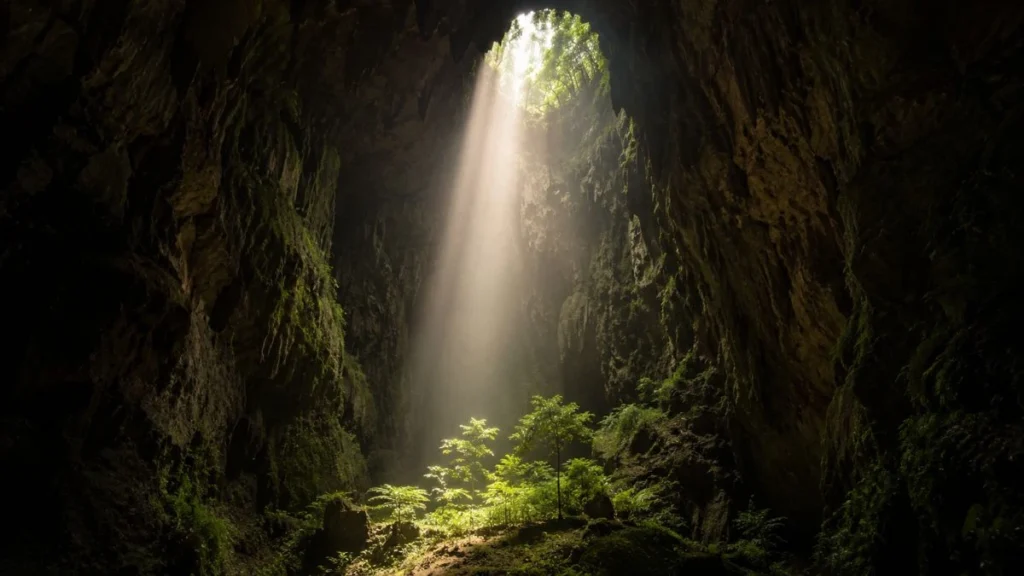
Jomblang Cave shows up in nearly every “things to do in Yogyakarta” roundup with the same dramatic photo: a beam of light cutting through darkness onto a green forest floor below. The photo is real. What’s usually left out is the queue, the quota system, and the gear-up process that comes before you get anywhere near that light.
Jomblang Cave has become one of the more talked-about things to do in Yogyakarta over the past several years, almost entirely because of that single shot — sunlight piercing a vertical cave opening onto a small pocket of primary forest growing at the bottom. It’s a genuinely rare geological feature, not a staged tourist setup. But the way it’s usually written about skips most of what actually shapes the experience.
What Jomblang Cave Actually Is
Jomblang is a vertical cave, formed by the collapse of a limestone cavern roof thousands of years ago. That collapse created what’s called a doline — essentially a deep sinkhole — at the bottom of which a small patch of ancient forest has grown, cut off from the surrounding landscape and developing its own self-contained ecosystem. Locals call this forest floor luweng, and the light beam that draws most visitors here, known as cahaya surga (heaven’s light), only appears clearly for a short window around midday when the sun lines up directly overhead.
Getting down to it isn’t a walk-in visit. Access is via vertical caving — a single-rope technique called Single Rope Technique (SRT) — meaning you’re lowered roughly 60 meters down into the doline using a harness and guide ropes, supervised by trained local operators. It’s not technical climbing experience you need; the system is built for first-timers. But it is a real descent, not a staircase.
The Part Most Articles Leave Out: The Queue
Because the light beam only lines up properly for a limited window around midday, and because the descent system can only process a certain number of visitors per hour for safety reasons, Jomblang operates on a quota basis — especially during peak season (school holidays, July–August, and around major Indonesian holidays). Visitors are grouped and sent down in batches, and during high season, the wait between arrival and your actual descent slot can run well over an hour, sometimes longer.
This is the trade-off that almost never makes it into the photo captions. You’re not booking a quick stop on the way to somewhere else — you’re committing the better part of a day once you factor in travel time from the city (roughly 1–1.5 hours each way), the wait for your slot, the descent itself, time at the bottom, and the ascent back up.
Whether that’s worth it depends on what you’re after. If the light-beam photo is the primary goal, it’s worth knowing the exact midday window can shift depending on season and weather, and a queue can eat into the time you’d actually spend at the bottom photographing it. If you’re more interested in the cave system and the rare ecosystem at the bottom as an experience in itself, the wait matters less, because the descent and the forest floor are worth seeing regardless of whether the light lines up perfectly that day.
What to Actually Bring and Expect
Operators typically provide the technical gear — harness, helmet, ropes — but expect to get genuinely wet and muddy; this isn’t a visit you do in clothes you care about. Closed-toe shoes with grip are non-negotiable, and a change of clothes for the ride back is worth packing. Most tour operators bundle Jomblang with a second nearby cave, Grubug, as part of the same package, which extends the day further but adds a different kind of cave experience — a river cave rather than a vertical light shaft.
Is It Worth Including in Your Yogyakarta Itinerary?
Given the time commitment, Jomblang works best as a dedicated day, not something squeezed between other sights. If your trip already includes a highland or Gunungkidul-focused day, it pairs reasonably well — but trying to combine it with city-center sights like the Kraton or Taman Sari on the same day is unrealistic once travel time and queues are factored in.
We cover how to weigh this against other Yogyakarta highlights, and how to build a realistic schedule around it, in our broader guide to things to do in Yogyakarta.
Frequently Asked Questions
Do you need caving experience to visit Jomblang Cave?
No. The descent uses a guided Single Rope Technique system designed for first-timers, with trained local operators managing the harness and ropes. Reasonable physical fitness helps, but technical climbing experience isn’t required.
How long does a Jomblang Cave visit actually take?
Including travel from central Yogyakarta, queue time, the descent, time at the bottom, and the return, plan for a full day — typically 6 to 8 hours total, longer during peak season when queues are at their worst.
When is the best time to see the light beam at Jomblang Cave?
The light beam effect is generally clearest around midday, roughly between 11am and 1pm, though the exact window shifts slightly with season and weather. Arriving early to secure a midday descent slot improves your chances.
Is Jomblang Cave worth the queue during peak season?
It depends on your priorities. If the light-beam photo is the main draw, peak-season queues can eat into your time at the bottom during the ideal light window. If you’re more interested in the descent and the forest ecosystem itself, the wait matters less.