Last updated: 7 August 2026
This isn’t a float-through cave like Pindul or Kalisuci — Goa Cerme is a wade-through pilgrimage cave, waist-deep in places, where visitors follow the same 1.5-kilometer underground passage that local tradition says once hosted a meeting of Java’s most revered Islamic saints.
Quick Facts
- What it is: A 1.5km limestone cave straddling Bantul and Gunungkidul, tied to Walisongo history
- Where it is: Srunggo, Selopamioro, Imogiri (entrance) — exits near Ploso, Giritirto, Gunungkidul
- Price: A few thousand rupiah entry plus mandatory guide, helmet, and flashlight rental
- Altitude: Roughly 500 meters above sea level
- Note: A local guide is required — the cave has confusing branching passages
Goa Cerme sits in the hills south of Imogiri, straddling the border between Bantul and Gunungkidul regencies. Unlike Yogyakarta’s better-known cave-tubing spots, this one isn’t about floating on an inner tube — it’s a walking (and often wading) route through a 1.5-kilometer limestone passage, with an entrance in Bantul and an exit roughly 30km south in Gunungkidul. The name itself carries historical weight: local tradition ties it to gatherings of the Walisongo, the group of revered Islamic saints credited with spreading Islam across Java.
A Meeting Place for the Walisongo
According to Yogyakarta’s official tourism portal, Goa Cerme was reportedly used in the past as a meeting place for the Walisongo to discuss Islamic outreach and the establishment of the Great Mosque of Demak — one of Java’s most historically significant mosques. The name “Cerme” is widely believed to derive from the word “ceramah,” meaning a talk or discourse, referencing the discussions said to have taken place inside the cave.
Local accounts add further texture to this history, associating the cave specifically with figures like Sunan Kalijaga and Sunan Geseng, both central figures in the Islamic Java tradition, describing the cave as a spot used for religious teaching and meditation. Inside the cave, several named chambers are still associated with specific ritual uses — spaces locals refer to as spots historically used for meditation by puppeteers, singers, comedians, and religious teachers respectively, reflecting how deeply the site is woven into local spiritual practice rather than treated purely as a geological curiosity.
What Makes the Route Different
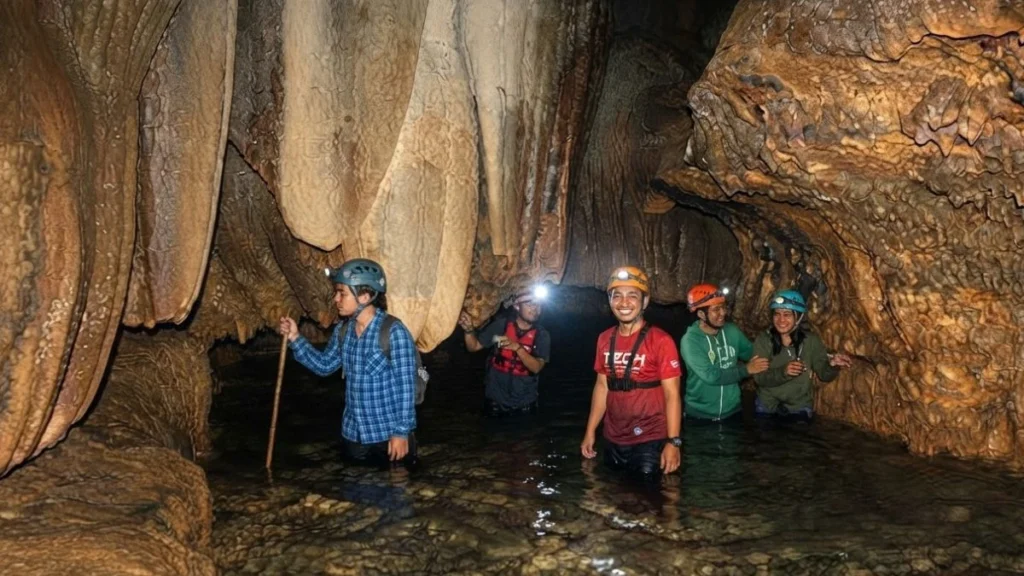
Goa Cerme sits at roughly 500 meters above sea level and offers stalactite and stalagmite formations alongside waterfalls and underground rivers that run through the cave. What sets the experience apart from Yogyakarta’s tubing caves is the method of exploration: there’s no float or tube involved here. Visitors walk and wade directly through the passage, and at some points the water reaches waist to chest height on an average adult, meaning a change of clothes is essential rather than optional.
A guide is required before entering, since the cave contains confusing branching passages that make it easy to get lost without local knowledge. Equipment like helmets and flashlights can typically be rented from stalls near the entrance rather than needing to be brought from the city. It’s also worth knowing that the cave’s water isn’t purely for tourism — locals in the area still use parts of it for daily activities like washing clothes, so don’t be surprised to see everyday village life happening alongside the guided tours.
Getting There
The route from Yogyakarta heads south through Giwangan Terminal and the East Imogiri road, continuing toward Siluk and Selopamioro. After crossing the Oyo River bridge at Siluk, a junction leads toward the cave’s parking area, with the final stretch climbing uphill. The full trip typically takes visitors through the length of the passage to the Gunungkidul exit, which means arranging return transport back to the Bantul side is worth planning ahead of time with your guide.
Because Goa Cerme sits south of Imogiri, it fits naturally into a day that also includes imogiri royal cemetery, given the shared route south from the city. For visitors comparing Gunungkidul’s different cave experiences, it’s worth noting how different this pilgrimage-style walk is from the float-based routes at kalisuci cave tubing or jomblang cave — Goa Cerme rewards a different kind of visitor, one drawn more to history and quiet ritual than adrenaline.
Practical Tips
- Bring a full change of clothes. Water levels inside can reach chest height on adults, so you will get completely wet.
- Always go with a guide. The branching tunnels make this a genuine safety requirement, not just a suggestion.
- Wear grippy footwear. Wet limestone underfoot can be slick, and the walk isn’t a casual stroll.
- Ask about the exit-side pickup. Since the cave runs through to Gunungkidul, confirm how you’ll get back to your starting point before setting off.
Is It Worth Visiting?
Yes, particularly for visitors drawn to Yogyakarta’s spiritual and historical layers rather than pure adventure tourism. Goa Cerme offers a genuinely different cave experience from the region’s more famous tubing spots — slower, more physically demanding in a different way, and tied to a specific piece of Javanese Islamic history that adds real weight to the walk through the dark.
What does the name “Cerme” mean?
It’s widely believed to come from the word “ceramah” (a talk or discourse), referencing discussions the Walisongo are said to have held inside the cave.
Do I need a guide to enter Goa Cerme?
Yes — a local guide is required because the cave contains confusing branching passages that make it easy to get lost without local knowledge.
How long is Goa Cerme?
The cave stretches approximately 1.5 kilometers, with its entrance in Bantul Regency and its exit near Ploso village in Gunungkidul Regency.
How wet do you get exploring Goa Cerme?
Quite wet — water levels inside can reach waist to chest height on an average adult at some points, so a change of clothes is essential.
How is Goa Cerme different from Goa Pindul or Kalisuci?
Goa Cerme is explored on foot with wading through water rather than floating on an inner tube, and it carries specific religious and historical significance tied to the Walisongo rather than being primarily an adventure-tourism site.
Sumber Resmi
- Yogyakarta Tourism Portal — Cerme Cave (diverifikasi aktif via fetch, diakses 7 Agustus 2026) — sumber resmi Dinas Pariwisata DIY untuk sejarah, deskripsi rute, dan kondisi eksplorasi gua