Last updated: 4 August 2026
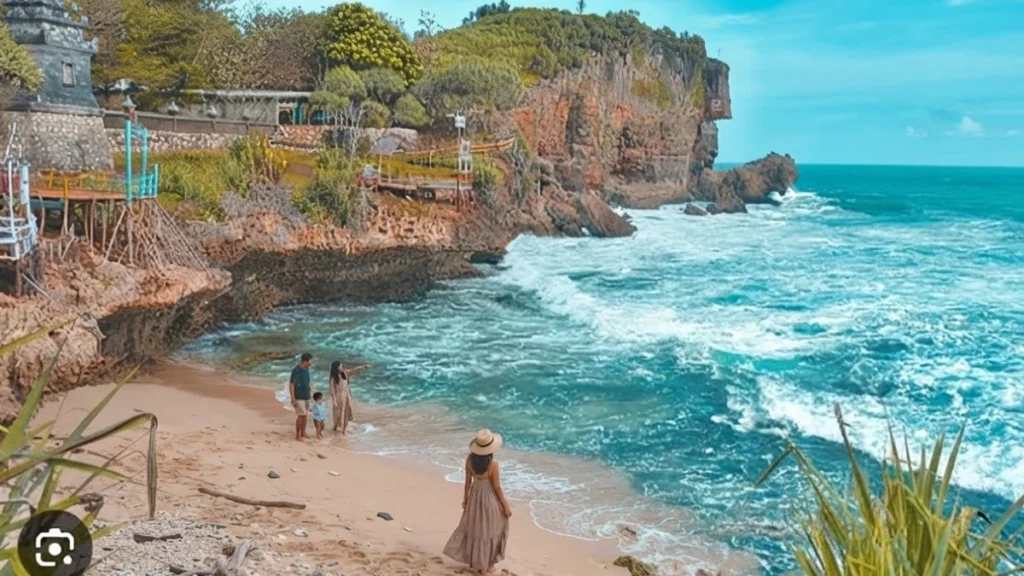
Pantai Ngobaran doesn’t look like the rest of Gunungkidul’s coastline — a Balinese-style Hindu temple sits on one side of the cliff terrace, a roofless prayer room on the other, both facing the same stretch of ocean.
Quick Facts
- Distance from Yogyakarta: ~50 km, 2–3 hours
- Swimming: Not recommended — rough seas
- Paired with: Ngrenehan Beach, ~15 minutes away
- Special ceremony: Melasti, held near the full moon around Nyepi
- Etiquette: Modest, respectful behavior expected near the active temple, especially during ceremonies
While the broader gunungkidul beaches guide covers the region’s coastline generally, Ngobaran stands apart for reasons that have nothing to do with sand or surf, closer in spirit to the mixed cultural traditions covered in javanese culture yogyakarta. It sits about 50 km southeast of central Yogyakarta, and its cliffside terrace holds a genuinely unusual mix of religious structures rarely found together on a single stretch of beach.
A Beach Built Around Two Faiths
The terrace above Ngobaran’s shoreline holds a Javanese-style Hindu temple, similar in design to temples commonly seen in Bali, standing alongside the remains of a roofless Muslim prayer room and a scattering of white goddess statues. The mix reflects the beach’s local spiritual history — it’s tied to legends connecting the site to King Brawijaya of the Majapahit Kingdom, whose figure Sabdo Palon Ngoyogenggong is associated with the area’s folklore.
Every full moon coinciding with Nyepi (the Balinese Hindu Day of Silence), Ngobaran hosts a Melasti ceremony — a Hindu purification ritual performed at the sea, drawing local practitioners to the beach for a ceremony most visitors wouldn’t expect to see on Java’s southern coast, an island otherwise overwhelmingly Muslim.
What Else Is Here
Beyond the temple and prayer room, a small local tradition has grown up around a stone near the terrace edge with an imprinted handprint — visitors who can fit their fingers into the mold are said to receive good fortune. The sea itself is rough here, unsuitable for swimming or surfing, but the tidal flats reveal seaweed, sea urchins, and shells at low tide, and a cave in the area is known for an underground stream running beneath the cliffs.
Pairing It With Ngrenehan
Ngobaran sits close enough to Ngrenehan Beach — roughly a 15-minute ride, or a short walk over the connecting hill — that the two are almost always visited together. Where Ngobaran offers the cultural and spiritual sites, Ngrenehan functions as a working fishing harbor and informal seafood market, with boats bringing in fresh catches that visitors can buy or have grilled on the spot. The pairing gives a day at Ngobaran both a cultural and a culinary side.
Getting There
The standard route from Yogyakarta runs through Piyungan, Patuk, Sambipitu, and Gading before turning toward Playen, Paliyan, and Kanigoro village, where signage marks the turn toward both Ngrenehan and Ngobaran. Given the distance and rural roads, a private car or rented scooter is the practical way to visit, and the trip typically takes two to three hours depending on traffic and route.
Is It Worth Visiting?
For travelers who’ve already covered Gunungkidul’s more conventional beaches and want something with a different character, yes — the combination of unusual religious architecture, folklore, and a working fishing village nearby makes Ngobaran feel distinct from a standard beach stop, in the same way kraton ceremonies offer a different lens on local tradition than a typical sightseeing stop. It’s not a swimming destination, so visitors expecting calm water or classic beach activities should adjust expectations accordingly.
Can I swim at Pantai Ngobaran?
No, the sea here is generally too rough for swimming or surfing; the appeal is the cliffside terrace, temple architecture, and tidal exploration rather than water activities.
Is the Hindu temple open for non-Hindu visitors to view?
Yes, visitors can view and photograph the temple terrace respectfully; it’s an active religious site, so modest, respectful behavior is expected, especially during ceremonies.
How far is Ngobaran from Ngrenehan Beach?
They’re close — either a roughly 15-minute drive around the headland or a shorter walk directly over the connecting hill.
What’s the best time to visit Pantai Ngobaran?
Daytime for the temple views and tidal exploration; if your visit coincides with a full moon near Nyepi, you may catch the Melasti ceremony, though this depends on the Balinese Hindu calendar.
Why does a Hindu temple exist on Java’s mostly Muslim southern coast?
Local folklore ties the site to legends of King Brawijaya of the Majapahit Kingdom, and the mixed religious structures reflect this specific coastal community’s distinct spiritual history rather than a broader regional pattern.