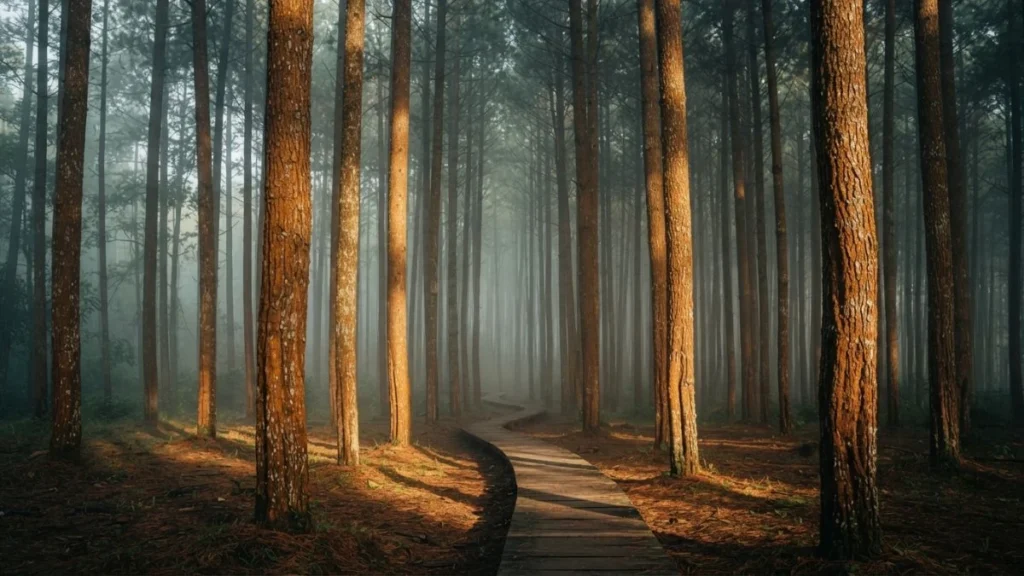
The pine forest photographs from Yogyakarta circulate widely on social media — tall Sumatran pines rising in near-perfect rows, shafts of morning light cutting through the canopy, a stillness that looks almost Scandinavian. What the photographs rarely show is that there are actually several distinct pine forest sites in the southern highlands, that they’re different from each other in character, and that the best version of the experience requires showing up significantly earlier than most visitors do.
Last updated: 31 July 2026
Pine forest Yogyakarta refers most commonly to the Mangunan area in Bantul Regency, approximately 24 kilometers south of the city center, where several distinct forest sites have developed into visitor destinations over the past decade. Hutan Pinus Mangunan is located in Sukorame, Mangunan village, Bantul, Special Region of Yogyakarta — roughly 24 kilometers from Yogyakarta, where arrays of gigantic pines populate 500 hectares of highland terrain. Standing at more than 30 meters, the Sumatran pine trees create a distinctive canopy that immediately changes the sensory character of the landscape.
The visual appeal is specific and genuine: the Pinus Merkusii (Sumatran pine) creates a dramatically vertical canopy that feels unlike anything else in the Yogyakarta region, and the combination of cool highland air, pine aroma, and filtered morning light produces an atmosphere that has nothing in common with the heat and noise of the temple circuit below. The honest qualifier is that the site has become significantly busier since it went viral on Indonesian social media around 2018 — the morning stillness the photographs imply is available, but only if you arrive early enough.
What Pine Forest Yogyakarta Actually Looks Like on the Ground
The Mangunan area contains several distinct sites within a few kilometers of each other, and distinguishing between them before you go matters:
Hutan Pinus Mangunan is the main forest — the 500-hectare managed plantation where the tall pines and boardwalk experience happen. A well-maintained boardwalk winds through the forest, perfect for leisurely strolls and capturing nature photos. The towering Sumatran pines create a breathtaking natural canopy, offering a refreshing scent and peaceful ambiance. This is the most photographed version of the Yogyakarta pine forest. Entry is effectively free — you are not charged an entrance fee, only a small parking fee of a few thousand IDR.
Hutan Pinus Pengger is a separate site a short distance away, more developed as a tourist destination, with unique man-made structures thoughtfully placed among the trees, including artistic installations and viewing platforms offering panoramic views of the city lights below at night. The “Tangan” viewpoint — shaped like a giant hand — is particularly popular for its sweeping views. Pengger attracts a different crowd from Mangunan — more oriented toward selfie spots and sunset city views than toward the atmospheric forest walk experience of Mangunan proper.
Bukit Panguk Kediwung — near the same area — offers sunrise views above the cloud layer on clear mornings, and has become a popular early morning destination for the same crowd drawn to highland viewpoints around Yogyakarta.
Pine Forest Yogyakarta: When and How to Visit
Visit Hutan Pinus Mangunan very early in the morning to experience its true peace and quiet. The timing advice is not incidental — weekend mornings by 9am bring enough visitors that the stillness the photographs imply has mostly gone. A genuine pine forest atmosphere requires arriving at or shortly after opening at 6am, when the mist from the previous night’s humidity is still in the lower canopy and the light is at its most directional.
Weekday mornings are the most consistently atmospheric. The difference between a Monday at 6:30am and a Saturday at 10am at Hutan Pinus Mangunan is not a difference of degree — it’s a qualitatively different experience.
Hutan Pinus Mangunan opens every day from 6am to 5:30pm. The forest works in any weather — overcast and slightly misty conditions are actually better for the pine forest atmosphere than strong direct sunlight, which flattens the visual texture that makes the canopy interesting to photograph.
The Surrounding Area: What Pairs With a Pine Forest Visit
The Mangunan area sits in the same southern highland corridor as Imogiri Royal Cemetery — approximately 5 to 7 kilometers apart — making a combined visit one of the more unusual half-days available from Yogyakarta. The tonal contrast between the two is striking: the pine forest’s quiet natural atmosphere and the Imogiri cemetery’s formal sacred stillness are different versions of the same quality — an unhurried, contemplative slowness that the city and the temple circuit don’t provide. The Imogiri Royal Cemetery guide covers the access requirements and timing for that visit.
Parangtritis beach is also in the southern direction from Yogyakarta, though it extends the day significantly — Mangunan to Parangtritis adds about 30 to 40 minutes of additional driving. For a full southern corridor day, the sequence of pine forest in the morning, Imogiri at midday (on open days), and Parangtritis for sunset covers a range of character that uses the direction efficiently. The Parangtritis beach guide covers the beach visit in detail.
Getting There and Practical Notes
There is no public transportation from downtown to Hutan Pinus Mangunan. Hiring a private car is the most practical option — a private car rental for 12 hours including driver runs approximately Rp350,000 to Rp700,000. Motorcycles are also an option, but the roads near the location are narrow and steep.
The road from Yogyakarta south toward Dlingo and Mangunan is paved throughout but involves significant elevation change and winding sections — confident motorbike riders handle it without difficulty, but it’s worth knowing the road character before deciding on a rented motorbike versus a private car. A rented motorbike gives more flexibility to stop at viewpoints along the highland road, which is part of what makes the Mangunan area rewarding as a day trip rather than purely as a destination.
Navigating between Mangunan, Pengger, and Bukit Panguk requires a maps application rather than signage — the sites are close but the road network between them isn’t always intuitive, and offline maps are recommended for the Dlingo area where data signal can be patchy.
What the Pine Forest Is Not
The pine forest of Yogyakarta is not a pristine wilderness — it’s a managed plantation forest (RPH, Resor Pengelolaan Hutan) that happens to have developed significant visual appeal and, more recently, visitor infrastructure. The installations at Pengger — the hand-shaped viewpoint, the selfie spots — are well-meaning additions that suit the domestic tourism market but change the atmosphere from serene pine forest to developed attraction. Mangunan proper has fewer of these additions and retains more of the character that made both sites worth visiting in the first place.
The honest visit prioritizes arrival time over anything else. “This is a cool natural area that has interesting tree formations. There’s a boardwalk to walk around and some cool view spots. Definitely better with no people around. I recommend coming very early in the morning.”
The Bottom Line
Hutan Pinus Mangunan delivers exactly what the photographs suggest — but only at the right time of day. Arrive at or shortly after 6am on a weekday, and the Sumatran pine canopy, the filtered morning light, the cool highland air, and the pine aroma combine into something genuinely worth the 24-kilometer drive from the city. Arrive on a weekend morning after 9am and you’ll find a pleasant enough forest walk with considerably more company than the social media version implies. The site is free to enter, easy to add to a southern highlands day alongside Imogiri or Parangtritis, and different enough in character from the rest of the Yogyakarta day trip circuit to feel like a distinct addition rather than more of the same.
Frequently Asked Questions
Where is the pine forest in Yogyakarta located?
Hutan Pinus Mangunan is located in Sukorame, Mangunan village, Dlingo, Bantul Regency — approximately 24 kilometers south of central Yogyakarta. Hutan Pinus Pengger is a separate site a few kilometers away in the same highland area. Both are in the southern Bantul highlands rather than in the city or the Prambanan eastern corridor.
What is the entrance fee for Hutan Pinus Mangunan?
Entry to Hutan Pinus Mangunan is free — visitors pay only a small parking fee of a few thousand IDR. The forest is open every day from 6:00 AM to 5:30 PM.
What is the difference between Hutan Pinus Mangunan and Hutan Pinus Pengger?
Hutan Pinus Mangunan is the main 500-hectare plantation forest with a boardwalk and more natural atmosphere. Hutan Pinus Pengger is a nearby but separate site with additional tourist installations including the “Tangan” (hand-shaped) viewpoint and city lights views in the evening — more developed for photo tourism, less purely atmospheric. Both are worth knowing about; which to prioritize depends on whether you want natural forest experience (Mangunan) or sunset city views and selfie installations (Pengger).
What is the best time to visit the pine forest in Yogyakarta?
Early morning, ideally at opening time (6:00 AM) on a weekday. Mist, directional light, pine aroma, and minimal crowds combine at this time to produce the experience the photographs suggest. Weekend mornings by 9–10 AM bring enough visitors to change the atmosphere significantly.
How do I get to Hutan Pinus Mangunan from Yogyakarta?
No public transport serves the route — a rented motorbike or private car with driver is necessary. The road is paved but involves significant elevation change and winding sections through the Dlingo highlands. Journey time from central Yogyakarta is approximately 45 to 60 minutes depending on traffic and route.