Walk through the weapons room at Sonobudoyo Museum and you’ll see 1,200 keris — daggers of varying sizes, ages, and regional styles mounted in rows behind glass. Most visitors pass through in ten minutes. The ones who slow down are the ones who’ve understood that a keris is not a weapon in the conventional sense, and that what separates one blade from another isn’t just craftsmanship — it’s a cosmological claim about the object’s character, its history, and what it’s capable of.
Keris Yogyakarta is the most specific and most accessible window into this tradition because Yogyakarta’s royal court has been one of the primary centers of keris culture in Java for centuries. The kris or keris is a distinctive, asymmetrical dagger from Indonesia — both weapon and spiritual object, considered to possess magical powers. The earliest known kris go back to the tenth century and most probably spread from the island of Java throughout South-East Asia. The keris you see in Yogyakarta today — worn by court officials at ceremonies, displayed in the Sonobudoyo collection, sold by specialists in the older parts of the city — exists within a tradition that has been continuous in this place for over a millennium.
What the Keris Actually Is
Keris are used in many different respects: as weapons, as talismans with magical powers, as sanctified heirlooms, as equipment for court soldiers, as an accessory for ceremonial dress, as a symbol of heroism, as an indicator of social status, or simply to display their beauty. This is not a list of different keris categories — it is a description of what a single keris might be simultaneously. The same object that functions as ceremonial dress accessory for a Javanese court official carries a specific spiritual identity believed to influence its owner’s fortune and protection. The same blade passed down through family generations is understood as an heirloom with accumulated spiritual charge, not merely a historical artifact.
The word itself comes from the Old Javanese: the origin of the word kris derives from the old Javanese term ngiris, which means to slice, wedge, or sliver.
Keris Yogyakarta: The Anatomy of an Asymmetrical Blade
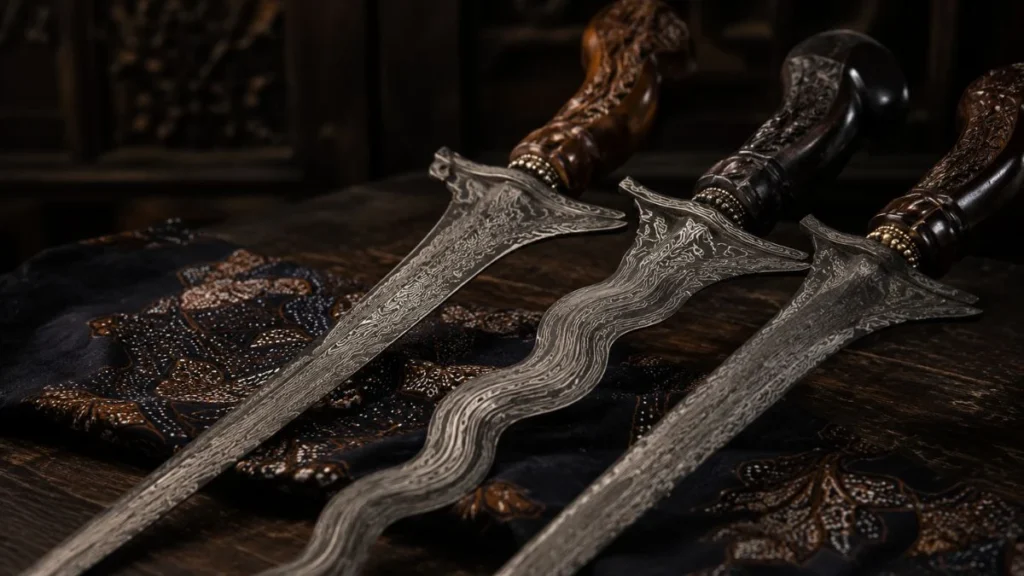
A kris’ aesthetic value covers three dimensions: the dhapur (the form and design of the blade, with some 40 variants), the pamor (the pattern of metal alloy decoration on the blade, with approximately 120 variants), and tangguh, referring to the age and origin of a kris. A bladesmith, or empu, makes the blade in layers of different iron ores and meteorite nickel.
The asymmetrical base that gives keris their distinctive silhouette is not decorative — it marks where the blade widens into the ganja, a structural element that separates the blade from the handle and has its own typology and meaning within the keris classification system. The wavy blade form (known as luk, with variants classified by the number of waves) is one of the most immediately recognizable features of the keris in its common depictions, though straight-bladed keris (known as lurus) exist and are equally significant within the tradition.
The pamor pattern — the visible result of folding and hammering iron with meteorite nickel — is not applied decoration but an intrinsic feature of the blade’s metallurgy. Different pamor patterns carry specific cultural associations. Some are considered auspicious for wealth; others for protection in conflict; others for charisma and social influence. A keris expert reads the pamor as part of the object’s character, not merely its appearance.
The Empu: The Bladesmith as Spiritual Practitioner
The empu — the master who forges a keris — occupies a different position in Javanese culture from an ordinary craftsperson. The forging of a keris is understood as a spiritual process as much as a technical one: the empu traditionally undertakes periods of fasting and meditation before beginning a significant blade, the work is accompanied by specific prayers and offerings, and the resulting object is considered to embody the spiritual intention of its making.
In 2005, UNESCO recognized the keris as an Intangible Cultural Heritage of Humanity from Indonesia, cementing its status as more than a sharp-edged weapon but a living embodiment of tradition and wisdom. More precisely, the keris was designated as a Masterpiece of the Oral and Intangible Heritage of Humanity by UNESCO on November 25, 2005, and inscribed on the Representative List of the Intangible Cultural Heritage in 2008.
The UNESCO recognition was partly a response to concern that the empu tradition itself was under pressure — the number of active empu who make keris through the traditional process (hand-forging, multiple metals, extended spiritual preparation) has declined significantly over the 20th century. Cultural organizations, royal courts in Yogyakarta and Surakarta, and local artisan communities continue supporting traditional craftsmanship through workshops, festivals, and educational programs. The Yogyakarta court’s continued involvement in this effort is one of the reasons Yogyakarta remains a particularly meaningful place to engage with keris culture rather than viewing it as a historical artifact.
The Keris in Javanese Daily and Ceremonial Life
Kris were worn everyday and at special ceremonies, and heirloom blades are handed down through successive generations. Both men and women wear them. The ceremonial dimension remains active in Yogyakarta in ways that are directly visible to visitors: at the Kraton’s formal ceremonies, court officials wear the keris tucked into the back of the waistband — a specific wearing position associated with the Javanese tradition that differs from other regional practices.
The keris remains an integral part of weddings, where it symbolizes the groom’s readiness and responsibility, and is featured in wayang (shadow puppet) theatre and dance. The keris character in wayang is Arjuna’s weapon Pasopati, associated with precision and spiritual refinement rather than brute force — which is consistent with how the keris is generally positioned within Javanese cultural values: not as an instrument of aggression but as an extension of the owner’s inner refinement.
There is a tradition of “bathing” the keris (jamasan) in special flower water once a year, usually during the Javanese New Year (Suro). The jamasan ceremony at the Kraton — when the royal heirloom keris collection is cleaned and spiritually renewed — is one of the most significant events on the court’s annual calendar and is connected to the same ceremonial framework covered in the Kraton ceremonies guide.
Where to See Keris in Yogyakarta
The Sonobudoyo Museum holds 1,200 keris from across the archipelago — the single largest accessible collection for visitors. The full context of what else the museum contains is in the Sonobudoyo Museum guide.
The Kraton museum section holds the palace’s own heirloom keris, which carry the accumulated history of the Yogyakarta sultans rather than the broad regional survey of the Sonobudoyo collection. These are a different kind of object — not the most formally perfect blades but the ones with the most specific historical and spiritual charge within the court’s own tradition. The Kraton Yogyakarta guide covers the full palace visit context.
For visitors interested in buying a keris rather than simply viewing one, the older quarters of Yogyakarta — particularly in the lanes south of the Kraton and in specialized dealers in the Kotagede area — have dealers who sell keris across a wide range of ages, origins, and prices. The same principle that applies to buying batik or silver in Yogyakarta applies to keris: understanding what you’re looking at before you buy it produces a more considered purchase than selecting by price or appearance alone. The Javanese culture and etiquette guide provides the cultural framework that makes the object’s significance legible before you shop.
Frequently Asked Questions
What is the keris and why is it important in Yogyakarta?
The keris is a distinctive asymmetrical dagger from Java with a tradition going back to the 10th century, functioning simultaneously as a weapon, spiritual object, heirloom, and ceremonial accessory. Yogyakarta is one of the primary centers of keris culture because of its royal court tradition, which has continuously supported keris craftsmanship and maintained significant heirloom collections.
Did UNESCO recognize the keris?
Yes — the keris was designated as a Masterpiece of the Oral and Intangible Heritage of Humanity by UNESCO on November 25, 2005, and inscribed on the Representative List of the Intangible Cultural Heritage in 2008.
What is pamor on a keris?
Pamor is the pattern of metal alloy visible on the keris blade, created by folding and hammering iron with meteorite nickel during the forging process. It is not applied decoration but an intrinsic feature of the blade’s metallurgy, with approximately 120 known variants, each carrying specific cultural associations related to the keris’s spiritual character and the fortune it brings to its owner.
Where can I see keris in Yogyakarta?
The Sonobudoyo Museum holds 1,200 keris in its weapons room — the most accessible collection for visitors. The Kraton museum section holds the royal heirloom keris collection with specific historical significance to the Yogyakarta sultanate. Specialist dealers in the lanes near the Kraton also sell keris across a range of ages and origins.
Can visitors buy a keris in Yogyakarta?
Yes — specialist dealers in the older parts of the city sell keris ranging from relatively modern pieces to antique blades with documented provenance. Prices vary enormously based on age, pamor pattern, empu origin, and condition. Understanding the basic classification system (dhapur, pamor, tangguh) before buying gives you a basis for the dealer conversation that purchasing by appearance alone doesn’t.