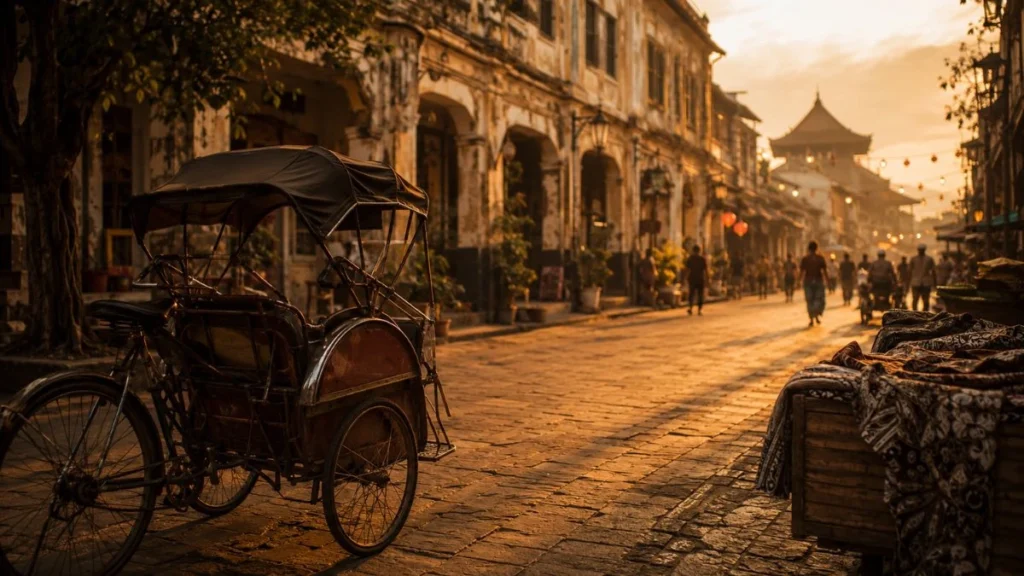
Javanese language basics Yogyakarta visitors should learn aren’t about becoming fluent—they’re about using a handful of phrases that make everyday interactions warmer and more respectful. Knowing just a few words of Javanese or Indonesian in Yogyakarta often creates a far stronger connection with locals than travelers expect. This guide covers the most useful expressions, when to use them, and the cultural context behind each one.
Javanese language basics matter in Yogyakarta in a way that’s specific to this city and this cultural context. Yogyakarta is one of the centers of Javanese language and culture — the Kraton’s court language is considered the standard reference for formal Javanese, and the city’s identity is deeply tied to the preservation of Javanese as a living language. Attempting even a few words of Javanese or Bahasa Indonesia here signals something different from the same attempt in a generic tourist destination: it signals that you’ve paid attention, that you’re interested in where you actually are, and that you’re engaging with the city as a place rather than as a backdrop. The response that generates — warmth, openness, often a great deal of delight — is worth the small effort the phrases take to learn.
The Language Landscape: Indonesian vs Javanese
Understanding the two-language context is the starting point for knowing what to learn. Yogyakarta’s daily life operates across two languages that most visitors don’t distinguish between.
Bahasa Indonesia is the national language — the formal, official language of education, government, media, and business across Indonesia. It’s what you’ll encounter on signs, menus, official communications, and in any interaction with services aimed at visitors. It has no tonal system, no grammatical gender, and a relatively straightforward structure that makes the basics accessible to most Western language learners in a short time.
Javanese (Basa Jawa) is the regional language — the first language of most Yogyakartans in their daily home and community life, and the language of the court, traditional arts, and ceremonial contexts. It’s significantly more complex than Indonesian, with multiple speech registers (ngoko for informal/peer contexts, krama for formal/respectful contexts) that reflect the hierarchical social values covered in the Javanese culture and etiquette guide. Visitors don’t need Javanese to navigate Yogyakarta — Indonesian is understood by everyone and used in all commercial and tourist contexts. But a few Javanese phrases used at the right moment produce a response that Indonesian or English doesn’t.
The practical strategy: learn Bahasa Indonesia basics for navigation and daily transactions, and learn a handful of Javanese phrases specifically for their social value in cultural contexts (at the Kraton, in craft workshops, at warungs where the owner clearly prefers Javanese).
Essential Bahasa Indonesia for Yogyakarta
These are the phrases that cover most daily interactions — shopping, eating, transport, and basic courtesy.
Greetings and Basic Courtesy
Selamat pagi — Good morning (used until around 11am)
Selamat siang — Good midday (11am to around 3pm)
Selamat sore — Good afternoon (3pm to sunset)
Selamat malam — Good evening (after sunset)
The time-specific greetings matter more than a single all-purpose “hello” — using the correct one shows you’ve paid attention. Halo works as an informal all-purpose greeting but doesn’t carry the same social weight as the time-specific versions.
Terima kasih — Thank you
Sama-sama — You’re welcome (lit: “same-same”)
Permisi — Excuse me (when passing, entering, or getting attention)
Maaf — Sorry / Excuse me (for minor apologies)
Tolong — Please (when asking for help or making a request)
Nama saya [name] — My name is [name]
Dari mana? — Where are you from? (you’ll be asked this often)
Saya dari [country/city] — I’m from [country/city]
Shopping and Negotiating
Berapa harga? — How much does it cost?
Berapa harga ini? — How much is this?
Mahal sekali — Very expensive (useful in market negotiation)
Boleh kurang? — Can you reduce the price? (the standard opening for negotiation)
Terlalu mahal — Too expensive
Saya mau ini — I want this
Ada yang lebih murah? — Do you have something cheaper?
Tidak, terima kasih — No, thank you (for declining vendor approaches)
Eating and Food
Makan — To eat / food
Minum — To drink
Enak sekali — Very delicious (say this after eating — it will be appreciated)
Pedas — Spicy
Tidak pedas — Not spicy (request when ordering)
Saya tidak makan [daging/babi] — I don’t eat [meat/pork] (useful for dietary needs)
Sudah kenyang — I’m already full
Minta bon / Bayar — The bill / Pay (to ask for the check)
Air putih — Plain water
Es — Ice
Transport and Navigation
Di mana [tempat]? — Where is [place]?
Tolong antar ke [tempat] — Please take me to [place] (for drivers)
Berapa ke [tempat]? — How much to [place]?
Lurus — Straight ahead
Kanan — Right
Kiri — Left
Berhenti di sini — Stop here
Pelan-pelan — Slowly / slow down (useful in motorbike taxis on highland roads)
Useful Conversational Phrases
Saya tidak mengerti — I don’t understand
Bisa berbicara lebih lambat? — Can you speak more slowly?
Bahasa Inggris? — Do you speak English? (spoken as a question)
Tidak apa-apa — It’s okay / No problem
Sudah — Already done / finished (very versatile word)
Belum — Not yet (equally versatile)
Boleh foto? — May I take a photo? (always ask before photographing people)
Javanese Phrases Worth Learning
These are specifically for Yogyakarta and produce a response that Indonesian doesn’t — use them selectively but don’t be afraid to try.
Sugeng enjing — Good morning (Javanese krama, the polite register)
Sugeng siang — Good midday (Javanese krama)
Sugeng sonten — Good afternoon (Javanese krama)
Sugeng dalu — Good evening (Javanese krama)
These Javanese greetings used at the Kraton, at established craft workshops, or with older Yogyakartans will produce genuine surprise and warmth — very few visitors attempt them, and making the attempt communicates respect for the cultural context in a way that Indonesian greetings don’t quite manage.
Matur nuwun — Thank you (Javanese krama, more formal than the Indonesian terima kasih — use this at the Kraton, at temples, with older people)
Nggih — Yes (Javanese krama — the polite affirmative; sounds like “ngee-yeh”)
Mboten — No (Javanese krama — the polite negative)
Sampun — Already / finished (Javanese equivalent of Indonesian “sudah” — useful in market contexts)
Pripun kabare? — How are you? (Javanese krama — only use this if you’re prepared for a Javanese response, but it’s a phrase that generates significant goodwill)
Sae — Good / fine (the standard response to the above)
Monggo — Please / go ahead / welcome (Javanese — used to invite someone in, to offer something, to signal someone to proceed; you’ll hear it constantly in Yogyakarta from shopkeepers and hosts, and using it yourself is immediately understood as culturally attentive)
Numbers: The Non-Negotiable Basics
For market shopping and transport negotiation, knowing Indonesian numbers is more practically useful than any other vocabulary category.
- Satu — 1
- Dua — 2
- Tiga — 3
- Empat — 4
- Lima — 5
- Enam — 6
- Tujuh — 7
- Delapan — 8
- Sembilan — 9
- Sepuluh — 10
- Seratus — 100
- Seribu — 1,000
- Sepuluh ribu — 10,000
- Seratus ribu — 100,000
Indonesian prices are almost always in thousands or hundreds of thousands of Rupiah — understanding when someone says “tiga puluh ribu” (30,000) versus “tiga ratus ribu” (300,000) is the difference between paying the right amount and paying ten times too much.
Pronunciation Notes
Bahasa Indonesia pronunciation is largely phonetic and more consistent than English — letters are pronounced as written, without the silent letters and irregular vowel sounds that make English difficult.
Key sounds for English speakers: c in Indonesian is always pronounced “ch” (so “becak” is “be-CHAK,” not “be-SACK”); j is always “dj” sound (like the j in “jar”); vowels are pure sounds without diphthongs — a is “ah,” e is “eh,” i is “ee,” o is “oh,” u is “oo.”
The most commonly mispronounced tourist word in Yogyakarta: the city name itself. “Yogyakarta” is pronounced “Yog-ya-KAR-ta” with the stress on the third syllable — “Yog” rhymes with “log,” not “yoga.”
The Social Return on Language Effort
The Javanese culture and etiquette guide covers why the social texture of Yogyakarta operates the way it does — the value placed on rasa (social attentiveness) and the warmth generated by genuine effort to engage with the cultural context. Language is one of the most direct expressions of that effort, and in Yogyakarta specifically the attempt to use Javanese registers in the right contexts is recognized as coming from a place of genuine interest rather than tourist performance.
You don’t need to be fluent. You need to be genuinely trying, and in Yogyakarta that’s enough to change how people engage with you — in warungs, at craft workshops, at the Kraton, in conversations with older Yogyakartans who remember when foreign visitors didn’t attempt Javanese at all.
Frequently Asked Questions
Do people in Yogyakarta speak English?
English is widely understood in tourist-facing contexts — hotels, restaurants in the Prawirotaman area, major attractions. English becomes less reliable in local markets, craft workshops, smaller warungs, and among older residents. Indonesian fills the gap in most cases; Javanese fills it in cultural contexts where that matters.
Is Javanese or Indonesian more useful to learn for a Yogyakarta trip?
Indonesian for navigation, shopping, transport, and daily transactions — it’s the language that covers everything. Javanese for specific cultural contexts where the social impact of the attempt is disproportionately high: the Kraton, established craft workshops, interactions with older residents. You need both in small doses rather than depth in one.
How different is Javanese from Bahasa Indonesia?
Significantly different — they’re related but distinct languages. Javanese has a more complex structure, multiple speech registers based on social hierarchy, and different vocabulary throughout. Most functional Indonesian phrases will not be understood as Javanese. The good news is that the Javanese phrases most worth learning as a visitor are short and specific enough to be memorized in an evening.
Will people laugh at my Indonesian or Javanese?
Rarely and not unkindly — attempts at the local language in Yogyakarta are received with genuine warmth rather than amusement at errors. Pronunciation mistakes are common and understood without friction. The social risk of trying is essentially zero; the social return is real.